The Topps Baseball set from 1960 stands as their last full horizontal set and one of the most colorful ever produced. It's also the first set I actively 'chased' as a young collector. I hope you will enjoy checking out these great cards as much as I will enjoy posting them. Please leave a comment or criticism if you feel the need.
Showing posts with label Memorial Coliseum. Show all posts
Sunday, May 19, 2019
#88 John Roseboro
John Roseboro Los Angeles Dodgers
Career: He spent 11 seasons with the Dodgers before finishing his career with the Twins and Senators. He was a four-time All-Star and twice was awarded a Gold Glove. He played in four World Series with the Dodgers and won three rings. His outstanding career is sometimes overshadowed by the publicity he received stemming from the Juan Marichal 'bat incident' of 1965.
In 1960: He was sidelined for chunks of June and July and played the fewest games of any season during his stretch as the Dodgers' #1 catcher. His .213 average was the lowest of his career for a full season.
Off The Charts: Wikipedia sez..."After several years of bitterness over their famous altercation, Roseboro and Marichal became friends in the 1980s. Roseboro personally appealed to the Baseball Writers' Association of America not to hold the incident against Marichal after he was passed over for election to the Hall of Fame in his first two years of eligibility. Marichal was elected in 1983, and thanked Roseboro during his induction speech..."
The Card: Memorial Coliseum lurks ghost-like in the background. Topps opted for the capless shot even though they must have had others to use showing Roseboro in Dodgers gear. It wasn't like he'd been recently traded. He shares a special card, Dodger Backstops, with Joe Pignatano in this set. I featured it in 2015.
Wednesday, January 30, 2019
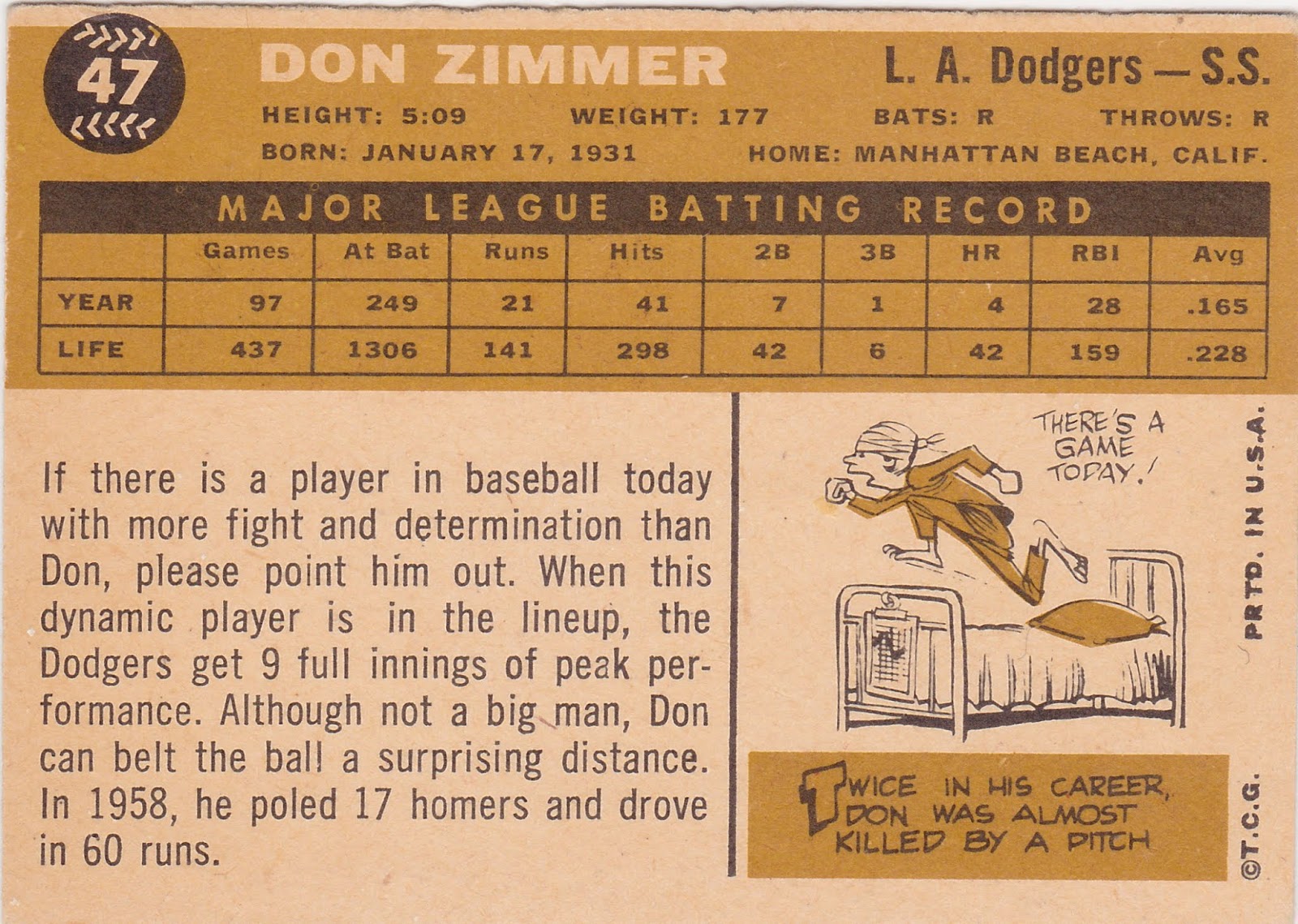
#47 Don Zimmer
Don Zimmer Los Angeles Dodgers
Career: Zimmer is probably the 'baseball lifer'. He said many times that he never drew a paycheck other than from a baseball team. He played a dozen years in the majors, about as many in the minors and Japan. He managed in the majors for 13 seasons and then coached into his 80s. Oh, and he worked as a coach and manager in the minors as well.
In 1960: He had already moved on to the Cubs when this card was issued. He was the regular second baseman on the North Side and hit .258 with six homers. He played one more season with the Cubs and made the 1961 All-Star team.
Off The Charts: Wikipedia sez: During a minor league game on July 7, 1953, Zimmer was struck by a pitch thrown by pitcher Jim Kirk, causing Zimmer to lose consciousness. He suffered a brain injury that required surgery. He woke up two weeks later, thinking that it was the day after the game where the incident took place. This led to Major League Baseball adopting batting helmets as a safety measure to be used by players when at-bat.
The Card: Love the shot of Zim with the Coliseum as the backdrop. I wish I could make out who the player behind him is but the number is unclear. The blurb on the back really sings his praises and the cartoon is one of the better ones and looks (to my eyes at least) to have been done by Jack Davis. Underrated card to be sure!
Wednesday, May 10, 2017
#478 Frank Torre
Frank Torre, Milwaukee Braves
Career: Frank Torre spent seven seasons in the majors with the Braves and Phils, primarily as a platoon first baseman. He was eight years older than brother Joe who made the Hall of Fame and still works for MLB. Frank was good with the glove and led the NL in several defensive categories in 1957 and 1958, his two most productive seasons. He hit .309 with six homers and 55 RBI in ;58 which showed he could handle a bat pretty well, too.
He spent two years with the Phils after the Braves sold his contract to them in December of 1961.
In 1960: This was his last season with Milwaukee and he spent most of it and all of 1961 back in the minors after his numbers dropped off the previous season.
WikiFacts: From his (highly entertaining) SABR bio:
After his playing career ended, Frank entered the sporting-goods business. Initially he and Joe operated a sporting-goods store. Frank then joined Adirondack Bats and became manager of the company’s professional division. Part of that job consisted of visiting all the major-league spring-training facilities in a trailer that served as a portable bat factory (Yes, the trailer was referred to as a “bat-mobile”) that provided custom-made bats to major leaguers. Inside the trailer were Adirondack craftsmen, as well as a special lathe and other equipment that produced a custom bat in 30 minutes that even included the player’s own signature.
The Card: That's Memorial Coliseum behind Torre. that background, the Braves classic uni and the color combo all add up to make this one of the nicer cards in the set.
Saturday, December 26, 2015
#165 Jack Sanford
Jack Sanford San Francisco Giants
Career: I cribbed most of this from my post of his 1959 Topps card:
If the term 'bad ass' had been popular back when pitcher Jack Sanford was active, he'd have been called one. He threw hard, didn't always know (or care) where the ball was going, and once was suspended for 10 games for refusing to give up the baseball when his manager came out to take him out of a game. That's bad ass.
Sanford tried out at a Red Sox camp in 1948 after high school but they thought he was too small and he wasn't signed. A Phillies scout had seen his performance and offered him a contract and he pitched until 1954 in their chain. His minor league career was marked by his inability to control either his fastball or his temper. He spent a year in the military and in 1957, his first full season in the bigs, he won 19, lost only 8 and posted a 3.08 ERA to earn NL Rookie of the Year honors. At this point he was 27 years old, not exactly a kid making his major league debut.
He was hit with the sophomore jinx in 1958 and his numbers slipped. The Phils traded him to the Giants for Valmy Thomas and Ruben Gomez in a move they regretted soon enough. Sanford rebounded and pitched very well in San Francisco for five seasons. His best year was 1962 when he won 24 games and finished second in the Cy Young voting. 16 of those 24 wins came consecutively. In 1963 the workhorse started a league high 42 games. (It's a different game today, Phil Niekro was the last pitcher to start that many, taking the mound 44 times in 1979.)
Sanford started three games in the 1962 Series for the Giants. He went 1-2 against the potent Yankee squad. He pitched very well in the series and in Game 7 he started and allowed only one run. Sadly for the Giants his club was shutout by Ralph Terry in the deciding game. Each of his Series starts, in fact, came against Terry.
He remained in the majors with the Giants, Angels and A's before retiring after the 1967 season and left with 137 career wins. Following that he coached for a couple of seasons in Cleveland and worked as a country club director.
Sanford died in 2000 of brain cancer. A well written blog post reminisces about his career.
In 1960: His ERA was up half a run from 1959 and he went 12-14 with a 1.3 WHIP. Just as it seemed that he was overcoming his control problems he lead the league with 15 wild pitches. He never again even approached that number. On the plus side he gave up the fewest homers per nine innings in the league.
WikiFacts: From his NY Times obit..."In 1962, Sanford won 16 straight starts from mid-June to mid-September en route to a 24-7 record for a Giants team that won the pennant in a three-game playoff against the Dodgers.
Only Rube Marquard, who won 19 straight for the New York Giants in 1912, and Roy Face, who won 17 straight for the Pittsburgh Pirates in 1959, have won more consecutive games in a single year during the modern era. Six pitchers have matched Sanford's 16-game streak."
From his SABR bio...."His fierce temper had not quieted. On the days he was scheduled to pitch, even his wife and four children knew better than to speak to him. After he arrived at the ballpark, he paced the clubhouse, scowling and silent, until it was time to warm up. When he disagreed with an umpire, he stomped around the mound, waving his arms and talking to himself. Catcher Hobie Landrith said, “I don’t think he saw the catcher, batter and umpire. I don’t think he saw anything. When he was out there he was one bundle of nerves that couldn’t wait to get the ball and throw it again. He never wanted the catcher even approaching him. ‘Give me the ball. Give me the ball! GIVE ME THE BALL!'"
The Card: Flat out one of the best in the set. Great color combo and Sanford even looks like a tough guy. I love the old 'windbreaker under the jersey' look. You never see that these days. My best guess is that the pic was taken in the L.A.Coliseum.
Wednesday, November 18, 2015
#408 Carl Furillo
Carl Furillo Los Angeles Dodgers
Career: Known for a consistent, high average bat and strong throwing arm Carl Furillo enjoyed a 15 year career with the Dodgers in Brooklyn and L.A. He held down an outfield spot for 13 seasons as a starter and finished with a .299 career average and 192 homers. He was a two time All Star and won the NL batting crown in 1953. He led the NL outfields in assists twice.
In 1960: This was the end of the line for Furillo. He started a couple of games and pinch hit in a few more before suffering a torn muscle and being released by the Dodgers in May. Before the year was out he had sued the Dodgers on the grounds that he had been cut while he was injured and, oddly, was hired by them as a spring training instructor. His lawsuit was upheld and he was granted a slightly higher monthly pension. It was also reported that he was blackballed and for that reason he never was hired as a coach or scout.
WikiFacts: from his New York Times obit:
His best season was in 1953 when he led the National League in batting with a .344 average. He won the title despite being sidelined with a broken finger incurred in a brawl. Furillo had been hit by a pitch from the New York Giants' Ruben Gomez, and then charged the Giant manager, Leo Durocher.I think I've heard Night Owl say the same thing.
"We hated the Giants," he recalled years later. "We just hated the uniform."
The Card: If I didn't know any better I'd say that was my Uncle Joe pictured on that card. hard to say where this photo was taken. I could make a case for Wrigley (is that the scoreboard?), the Polo Grounds (are those the apartment buildings?) or the Coliseum in LA.
The back is unique in that it list just two Season's Highlights and those both recall postseason exploits for Furillo. I think that's pretty cool.
BTW...Furillo to me is a Brooklyn Dodger, not a Los Angeles Dodger. Seeing him in a cap with 'LA' on it is always odd.
Subscribe to:
Posts (Atom)