Sunday, August 30, 2020

#245 Eddie Yost


Eddie Yost  Detroit Tigers

Career: Eddie Yost was known as 'The Walking Man", and for good reason. He led the AL in bases on balls six times and was in the Top 10 twelve times. The Brooklyn native signed with Washington in 1944 and debuted as a 17-year-old that year. He spent a year in the service and returned to the majors never having played a game in the minors.

Yost was an institution at third in Washington playing 14 seasons with the Senators. He made the 1952 AL All-Star team but didn't play in the game. He received some scattered MVP votes, even playing on some terrible clubs.

He was traded to the Tigers and was their starting third-baseman in 1959/60. He finished his playing career as a part-timer and player/coach with the Angels. Yost spent 23 seasons as a coach for the Senators, Mets, and Red Sox. He was on the staff of the Mets' NL title clubs in 1969 and 1973. He got his ring in '69.

He ranks eleventh on the all-time walks list

In 1960: This was Yost's final season as an everyday player. He led the AL in walks (again) and in .OBP for the second straight year. He hit a respectable .260 for the Tigers. They nonetheless left him unprotected in the expansion draft and he was taken 25th by the Angels.

Off The Charts: This is from a bio of Yost on DC Baseball History blog I stumbled across:
The Boston Red Sox invited Yost to work out with the team in Boston in 1943. They liked what they saw. But when the Sox sent a scout to his Brooklyn home to sign him, they learned, from his mother, that Eddie was in St. Louis with the Washington club. Yost signed with Washington before the 1944 season. Boston Manager and former Nats shortstop Joe Cronin told Washington Post sportswriter Shirley Povich at the time, “Any right handed hitter who would sign with Washington when he had a chance to shoot for our left field fence deserves no sympathy.” But the Nats had finished 2nd in 1943. Boston finished 7th.
Yost was the first Los Angeles Angel to appear in a game when he led off in the fledgling club's opener in Baltimore on April 11, 1961.

Yost earned a Masters in Physical education at NYU during the off-seasons in the early 50s. He had played baseball and basketball there as an undergrad before he joined the Senators.

The Card: Pencil scribbles on the reverse don't bug me much. I might dig up a better one when we get back to having card shows.

Saturday, August 29, 2020

#244 Hal Griggs


Hal Griggs   Washington Senators

Career: Hal Griggs pitched three full seasons in the majors, all with Washington. He began in the low minors in 1952 after a tryout with Hickory of the NC State League. His numbers were not good but he impressed with his 'live' arm. He was sold to the Senators and progressed up their chain and put together some fine minor league seasons. He made the '56 Senators without having pitched at the AAA level.

Griggs spent the majority of four-year tenure (spent most of 1957 in the minors) splitting time between the bullpen and a starter's role. After his days with the Nats he spent about four more years pitching winter ball and in the minors for a couple of organizations. He retired after the '63 season. He then turned to golf.

In 1960: Griggs was done with the majors, his last appearance coming the previous September on the final weekend of the '59 season. He split 1960 between three different minor league teams, at three different levels, for two organizations (Nats and Phils). His numbers were not particularly good with any of them.

Off The Charts: His given name is Harold Lloyd Griggs. Yes, he is named for the famous silent film star Harold Lloyd.

SABR sez: At the 23rd Annual National Baseball Players’ Golf Tournament, held at Miami Springs Golf Course, Griggs competed against big-league talent including Sandy Koufax, Duke Snider, and Maury Wills. The erstwhile Senator was only a shot off the lead after day one of the two-day February 1963 event. He finished with a respectable 36-hole 160, 12 shots behind tourney winner Virgil Trucks.

The Card: Cartoon reference to his on-the-field wedding. His SABR bio adds to it with this:
"Before his team’s game on June 20, 1952, Hal married Betty Robinson on the pitcher’s mound in Hickory. Regarding the site chosen for his nuptials, Griggs responded, “I couldn’t hit, so there was no sense getting married at home plate.”
The same bio reports:
According to one publication, he “kept the club’s spirits high with his sense of humor.”8 Griggs’s travel roommate and fellow pitcher Russ Kemmerer concurred. “He was a fun guy to be around,” said the hurler, “A prankster.” Another Washington pitcher, Dick Hyde, described Hal as a “good easy going southern boy….[who] liked his night life.” In the dugout, the nocturnally-active Griggs proclaimed his carefree philosophy: “I’m only going to be here once on this earth, and I’m really going to live it up.”

Friday, August 28, 2020

#243 Bubba Phillips


Bubba Phillips  Cleveland Indians

Career: Bubba Phillips was a better football than baseball player when he got to Southern Mississippi University. He'd only played softball in high school. But he became a diamond standout and he signed with the Tigers in 1948. He made the Tigers in 1955 after a minor league stretch and time in the Army. He played for the Tigers, Indians and White Sox as an outfielder and third baseman through 1964.

Phillips hit .255 for his career. He was never an all-star but got some scattered MVP votes in 1961.

In the 1959 World Series for the Sox, he played three games and went three for ten including a double.

In 1960: Despite a solid season in 1959 with the White Sox Phillips was dealt to the Indians as part of the trade that brought Minnie Minoso back to Chicago. Phillips went on to have the worst season of his career, hitting only .207 and losing his full-time job at third. But as noted, he bounced back with a nice season in 1961.

Off The Chart: Phillips had one small movie role, playing Coach Hardy for a 1981 biopic on Satchel Paige. The film, Don’t Look Back, starred Louis Gossett Jr. as Paige.

The Card: Fun cartoon of Bubba swimming with the fishes.

Thursday, August 27, 2020

Cardinals Team Trio #242 #218 #468


The 1960 Cardinals finished third in the NL behind the Pirates. They were in the second division (now, there's a term that dates me) for the first half of the season and then climbed as high as second, three games back, on August 12. That was the middle of a four-game series in Pittsburgh in which they'd won the first two. Then the Bucs came back to win the next two and the Cards dropped back, never to be that close again.

They were led by Ken Boyer who was more-or-less a one-man wrecking crew. He led the team in almost all offensive categories. Many by a significant margin. He was even third on the team in steals.

This was before Bob Gibson became Bob Gibson and the Cards' staff was anchored by 18-game winner Larry Jackson. Ernie Broglio won 21 games while appearing in 52, starting 24 and relieving in the rest. It was a different game back then. Lindy McDaniel was the team's closer.


Partially checked checklist back. I have no problem with checked checklists.

From my 5 Tool blog: Solly was in the second of three years (2.5 actually) as Cardinals' manager. A long time Cardinal, he had returned to St. Louis from a stint with the Phils and gave the role of player/manager a shot in 1959. He didn't play much, just getting 26 at-bats, but after finishing in 7th place he came back in 1960 solely as the skipper. His team finished third. He was let go as manager mid-way through 1961 with the Cards in fifth.

In his 1960 card, he props himself on the railing and gazes off into the middle distance. He's probably hoping Stan Musial will play a few more years.


Topps with the nice cartoon back as usual. Hemus is yelling at himself in his previous player-manager role. Clever.


The coaches' card has a couple of future managers and a couple of former Cardinals players.

Howie Pollet was the ace of the '46 Cardinals World Series-winning club. He also won a ring as the pitching coach for the '64 Cards. Harry Walker was the 1947 NL batting champ. He played for eleven seasons in the NL for the cards and three other clubs. He had managed the Cards for part of the 1955 season prior to being on the staff for this card. He later managed the Pirates and Astros as well as serving as UAB's first head baseball coach.

Johnny Keane never played in the majors thanks in no small part to a serious head injury he suffered as a player in the Cards' chain in 1935. He was on the club's staff as a coach beginning in 1959 and took over as manager midway through 1961. He put together back-to-back 93-win seasons on 1963/64, culminating in a World Series title. For that, he was shown the door but landed in New York as the Yankees manager. He was replacing his Series opposite, Yogi Berra, who was similarly fired after a pennant.

Ray Katt was a backup catcher for the cards and Giants throughout the 1950s. Despite what the card blub claims, Katt played in 15 games in 1959. He was a player/coach in that final year. Katt, a Texas native, went back to Texas in the early 60s and coached high school ball then became an acclaimed college coach over 22 years at Texas Lutheran.


Tuesday, August 25, 2020

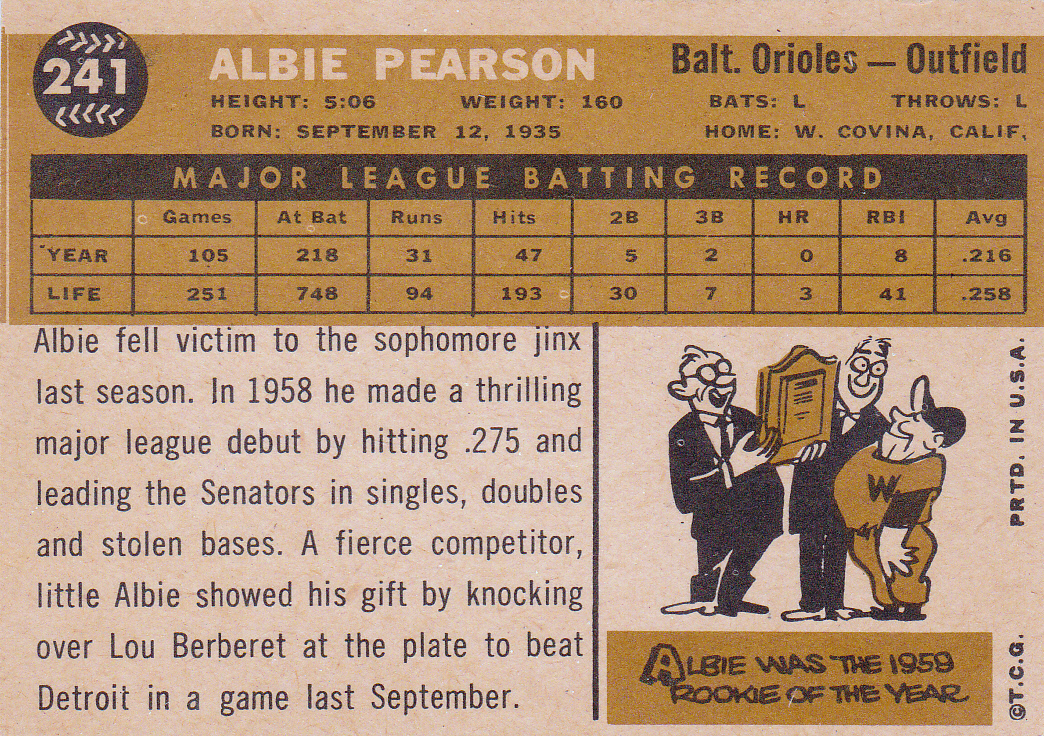
#241 Albie Pearson


Albie Pearson  Baltimore Orioles

Career: Pearson, one of baseball's most interesting characters, signed with the Red Sox in 1953. He had originally signed (for a song) as a pitcher but the Class C San Jose club was short on position players and Pearson was given a spot in the outfield. He was very successful in the Sox' chain but never was able to break through to the majors.

Boston traded Pearson to the Senators in January of 1958 and he became the Nats' starting centerfielder. He hit .275 and excelled in the field. He won the RoY award over Ryne Duren and Gary Bell. 

It can't be very often that a player comes off a Rookie of the Year season and finds himself dealt off within a few months. That's what happened to Pearson in 1959. He was hurt and his bat failed him and the Senators traded him to the Orioles in May.

The Angels drafted him from the Orioles in the '61 expansion draft and he played the rest of his career with the Halos. He had his best overall season in 1963 and made the All-Star starting lineup, getting a couple of hits in the game. He played into the 1966 season and then retired to devote his life to his Christian ministries. That work continues today.

In 1960: Pearson split the year between the Orioles and their Miami AAA club hitting .244 in 48 games as the Orioles fourth outfielder. 

Off the Charts: From my post of his 1959 Topps cards over on that blog...


Since his retirement, Pearson has served as an ordained minister and he and his wife established Father's Heart Ranch in Desert Hot Springs, California, a home for abused, neglected and abandoned boys. His foundation feeds Zambian youth who have lost their family to AIDS.

Pearson is a Renaissance man of sorts. He dabbled as a recording artist, actor, golfer, and disc jockey.

This 1963 article in Sports Illustrated is a fun read. It mentions how Pearson wrote letters to both the Red Sox and Angels trying to persuade them to take a chance on a 5' 5" ballplayer. And it recalls the advice he got from Ted Williams.

Ok, this is cool....Jackie Robinson hosted a series of short (<4 minutes) radio interviews in the late 50s, and one of his guests was Albie Pearson. Enjoy.


And here are a few shots of Albie and Marilyn Monroe taken as he escorted her onto the field for a 1962 pregame something at Dodger Stadium. Because why the hell not?


The Card: One of my favorites here. Albie's '59 card was in the first pack of Topps cards I ever opened, the only one I remember. So I have casually picked up more of his cards thru the years.

That's Orioles pitcher Arnie Portacerrero to Pearson's right with his back to the camera. Portacerrero will have a card coming up here soon. I believe (but wouldn't gamble on) that Griffith Stadium is where this was taken. Comisky also had those types of windows behind the home plate sections but these just seem different. They seem to be wider than those in the old Chicago place. If I could see just a bit more of the upper set of windows I'd know for sure. Comiskey's were very distinctive. They looked like silhouettes of the Astrodome.

Sunday, August 23, 2020

#240 Luis Aparicio


Luis Aparicio  Chicago White Sox

Career: Signed by the White Sox out of Venezuela in 1954 on the recommendation of fellow Venezuelan shortstop Chico Carrasquel, Luis Aparicio went on to play for 18 seasons as a shortstop for three AL clubs, the White Sox, Orioles, and Red Sox. He was the 1956 AL Rookie of the Year after leading the league in assists, putouts, and stolen bases.

He played in two World Series, facing the Dodgers both times. He was on the losing end in 1959 with the Sox but got his ring with the Orioles in 1966. He was a ten-time All-Star, won nine Gold Gloves and led the AL in steals for the first nine years of his career. Aparicio received MVP votes as a 22-year-old rookie and as a 38-year-old vet in his next-to-last season in Boston (and eight times in-between). In 1959 Aparicio was second in the MVP balloting to teammate Nellie Fox.

Aparicio was elected to the Hall of Fame in 1984. He is third on the list of games played at shortstop behind Omar Vizquel and Derek Jeter. He never appeared at another position other than shortstop.

In 1960: Coming off his near-MVP season Aparicio raised his numbers nearly across the board. His average jumped 20 points while his OPS, Slugging, and RBIs were also up. While he hit two homers as opposed to six the previous year and had eight fewer stolen bases, he again led the AL in almost every defensive category as a shortstop and he actually raised many of those stats. But his MVP share dropped to the point he was 22nd in the voting.

Off The Charts: Aparicio comes from a baseball family. His father, Luis Sr., was considered a superstar in Venezuela and has a stadium named for him in their hometown of Maracaibo. His uncle Ernesto, also a well-known player, was instrumental in teaching Luis Jr. the game. 

This quote is from Aparicio's page at the Hall of Fame site:


"He's the best I've ever seen,” former White Sox owner and future Hall of Famer Bill Veeck said in 1959. “He makes plays which I know can't possibly be made, yet he makes them almost every day.”


Friday, August 21, 2020

#239 Joe Shipley


Joe Shipley  San Francisco Giants

Career: Shipley had a bumpy 29 game career spread over four different seasons between 1958 and 1963. He began with the New York Giants in 1953 and spent eight years in their chain with three short looks at the majors.

Once the Giants sold him to Cleveland after the '60 season he bounced around through numerous organizations and pitched a partial season in Mexico as well. He lost his only major league decision during a brief time he had in the staff of the White Sox in 1963.

After his career ended he went back to his native Tennessee and was the baseball coach at East Tennessee State for over a decade.

His control problems on the mound were noted on the back of this card and humorously alluded to by former teammate and manager of the Giants, Felipe Alou.* This quote comes from a heavily firewalled (trust me) article on the SFGate website:

....Giants manager Felipe Alou said Giants pitcher Joe Shipley once heaved a fastball that went over the screen at Seals Stadium and clobbered a fan. "I heard he was ordered to hit somebody," says Alou. Mission accomplished. (Legend has it that as a minor-leaguer Shipley hit a batter who was in the on-deck circle.)

In 1960: He split the season (at least in terms of games) evenly between AAA Tacoma and San Francisco. He had 15 relief appearances for the Giants and although his ERA was ugly the rest of his numbers were decent, easily the best of his short career.

Off The Charts: The same SFGate article referenced above mentions that Shipley is reported to have once hit a batter...who was waiting his turn in the on-deck circle. It calls the tale a 'legend' and I can't find any mention of it anywhere else on the 'net. Or much else about Shipley either.

The Card: Nice color combo+Seals Stadium=a pretty cool card.

*=His 1959 rookie card had the same critique.