The Topps Baseball set from 1960 stands as their last full horizontal set and one of the most colorful ever produced. It's also the first set I actively 'chased' as a young collector. I hope you will enjoy checking out these great cards as much as I will enjoy posting them. Please leave a comment or criticism if you feel the need.
Tuesday, February 26, 2019
#54 Mike Fornieles
Mike Fornieles Boston Red Sox
Career: He's a native of Havana, Cuba and was one of many Cuban players signed by Senators' scout 'Papa' Joe Cambria. Ha had a terrific first year stateside in 'B' ball and was impressive in a late look in Washington but was traded to the White Sox after that first year. He was an occasional started early in his career but was primarily a reliever for four clubs over twelve seasons. His best years came with the Red Sox. He made the All-Star team in 1961 and pitched to three batters: George Altman (homer), Willie Mays (fly out) and Frank Robinson (single).
In 1960: Arguably his best season as he led the AL in appearances and was second in saves to go with a 10-5 record and a 2.64 ERA. He won the first The Sporting News Fireman of the Year Award in the AL.
Off The Charts: His SABR bio is pretty entertaining and tells us that: "With Washington scheduled for a doubleheader against the Philadelphia A’s on September 2, 1952, the Senators decided to promote a pitcher from the minor leagues and called down to Havana for Raul Sanchez, a right-hander with a 10-9 record. Many players need some degree of luck to get their first opportunity in the majors and Fornieles was one of those. Sanchez was too sick to report, so Havana sent up Fornieles instead and Washington gave the 20-year-old the start in the second game of the doubleheader.'
'...He turned in one of the best pitching debuts in major-league history, throwing a one-hit shutout in a 5-0 victory, allowing only a second-inning single to catcher Joe Astroth and retiring the last 14 batters in order."
The Card: Bonus points for a pink section! It's not a stretch to assume this pic was taken at the same session in Yankee Stadium as the pic used on his 1959 card. I blew them up and the same people appear in the background (or so it seems).
Monday, February 25, 2019
#53 Jackie Brandt
Jackie Brandt Baltimore Orioles
Career: Brandt was an outfielder for 11 seasons for five different clubs, most notably for the Orioles from 1960 through 1965. He was nicknamed 'Flakey' for his quirky personality. He was a great fielder with a lot of speed and he had a touch of power at the plate. His best season was 1961 when he hit a career-high .297 and made the AL All-Star squad.
In 1960: He came to the Orioles off his 1959 Gold Glove-winning season with the Giants. He was the Orioles' regular centerfielder but also appeared in left, right, at first and at third. His average fell off to the .250s but he was about to bounce back in '61.
Off The Charts: In interviews, Brandt jokingly takes credit for the Orioles 1966 title. He cites the fact that he was traded to the Phillies in December of 1965 for Jack Baldschum, who was then dealt to the Reds as part of the Frank Robinson trade. On a personal note..Brandt was in the lineup for my first game in two stadiums, Memorial in 1962 (he homered!) and the Astrodome in 1967.
The Card: He had been traded to the Orioles at the end of November of 1959. Time enough for Topps to change the team on the card but not enough for an Orioles photo. They were able to airbrush the uni in the 'action pose' photo though. Wrigley Field provided the backdrop. This isn't my favorite Brandt card but any O's card is a good O's card. If I had Photoshop skills I'd come up with an updated version.
Saturday, February 23, 2019
#52 Dave Philley
Dave Philley Philadelphia Phillies
Career: Eight teams, 18 seasons over the course of 21 years, a three year WWII military stint. Dave Philley had a lot of stories to tell at Old Timers games I'd bet. He began in 1941 with the White Sox, took some time for serving his country and then played almost 1900 more games before he retired in 1963 at the age of 43. That year, after a long big league career, he got in a few swings with the Colt 45s' minor league team in Modesto while serving primarily as a coach/instructor.
His SABR bio is good reading.
In 1960: He was dealt twice during the season, first from the Phils to the Giants, then from the Giants to the Orioles. He had a career-low .218 average as he neared the end of the playing trail.
Off The Charts: He earned Orioles' MVP honors in 1955 by hitting .299 in a role as a platoon outfielder and primary pinch hitter.
The Card: Connie Mack Stadium photo cards are easy to spot with those red seats. Of course, the Phils' red pinstripes is a giveaway as well. The first bullet highlight relates to the cartoon as Philley had a nice string of pinch-hit appearances dating back to the 1958 season.
Friday, February 22, 2019
#51 Jim Coates
Jim Coates New York Yankees
Career: It took Jim Coates more than six years to reach the majors for good after signing with the Yanks in 1952. He settled in as a spot starter/long reliever in '59 and had a 6-1 season and sub 3 ERA. He went on to pitch five years for the Yanks and another four with the Senators, Reds, and Angels. He hung on in the minors until 1970. He pitched in three World Series for NY and won a pair of rings.
In 1960: This was his best season in the majors. He won 13 games and led the AL in winning percentage. He made his only All-Star team and pitched two innings in the first of the two played that year. In Game 7 of the Series that year he relieved Bobby Shantz in the bottom of the eighth and nearly put out the fire by getting a couple of outs before he gave up a single to Roberto Clemente and a homer to Hal Smith (a couple of cards down the screen) which gave the Pirates a lead they'd blow and then regain in dramatic fashion.
Off The Charts: From Wikipedia...[Coates'] nickname, "The Mummy," came from his funereal visage on the mound ..... He was also well known for throwing at opposing batters. Jim Bouton, in his book, Ball Four, said Coates, after throwing at the opposing hitters, "would not get into the fights that followed." Coates now has a book entitled "Always a Yankee."
The Card: I wonder if they airbrushed his eyes or were they really that bright shade of blue?
Thursday, February 21, 2019
#49 Curt Raydon
Curt Raydon Pittsburgh Pirates
Career: Raydon was signed by the Braves in 1953 but a year later was dealt to the Pirates. He pitched his way to the big club over four seasons and had a fine rookie year in 1958. That season he made 20 starts for the Pirates, with 31 appearances in total. He went 8-4 with an ERA of 3.62 and an outstanding hits per IP ratio. He developed both a cyst in his pitching hand and a sore arm and never returned to the majors. He retired after the 1961 season.
In 1960: He had a second consecutive fine season in the Pirates chain. It's a bit surprising he never returned to the bigs after his 1858 rookie year.
Off the Charts: Here is an interesting (and damning) look at how players like Raydon were treated in regards to a baseball pension.
The Card: Great color combo and a shot of Raydon in Seals Stadium, no doubt taken in 1958. As for Raydon...I'd be smiling if I had a baseball card with a Jack Davis cartoon. Just sayin'.
Thursday, January 31, 2019
#48 Hal Smith
Hal Smith Pittsburgh Pirates
Career: Smith signed in 1949 with the Yankees (who seemed to sign every catcher in America) and was dealt to the Orioles where he emerged as the #1 catcher in 1955 before landing in Kansas City. He went on to play for the Pirates, Colt 45s and Reds in his 10-year career. He finished with a respectable.267 average and had three double-digit home run seasons.
In 1960: Lucky Hal came over from the bottom-of-the-standings Athletics to the Pirates just in time to be a part of the World Series championship. He went from getting into about 100 games a season in KC to just 77 with the Pirates. He hit .295 as he transitioned back to being a catcher after a few seasons playing primarily at third with the Athletics. In the World Series he was 3 for 8 and had a moment to remember. He hit a three-run homer in Game Seven to put the Pirates on top (temporarily) 9-7 in the bottom of the eighth. We all know what happened in the ninth.
Off The Charts: How's this for a Baseball Reference transaction entry?
November 17, 1954: [Smith was] Traded by the New York Yankees with players to be named later, Harry Byrd, Jim McDonald, Willy Miranda, Gus Triandos and Gene Woodling to the Baltimore Orioles for players to be named later, Billy Hunter, Don Larsen and Bob Turley. The New York Yankees sent Bill Miller (December 1, 1954), Kal Segrist (December 1, 1954), Don Leppert (December 1, 1954) and Theodore Del Guercio (minors) (December 1, 1954) to the Baltimore Orioles to complete the trade. The Baltimore Orioles sent Mike Blyzka (December 1, 1954), Darrell Johnson (December 1, 1954), Jim Fridley (December 1, 1954) and Dick Kryhoski (December 1, 1954) to the New York Yankees to complete the trade.
The Card: He's wearing Athletics duds and this is likely from Yankee Stadium but there's not much to go on. The golden orange, black and white is close to Pirates' colors which is nice. The listed highlights assume we know he played for the A's in 1959.
Wednesday, January 30, 2019
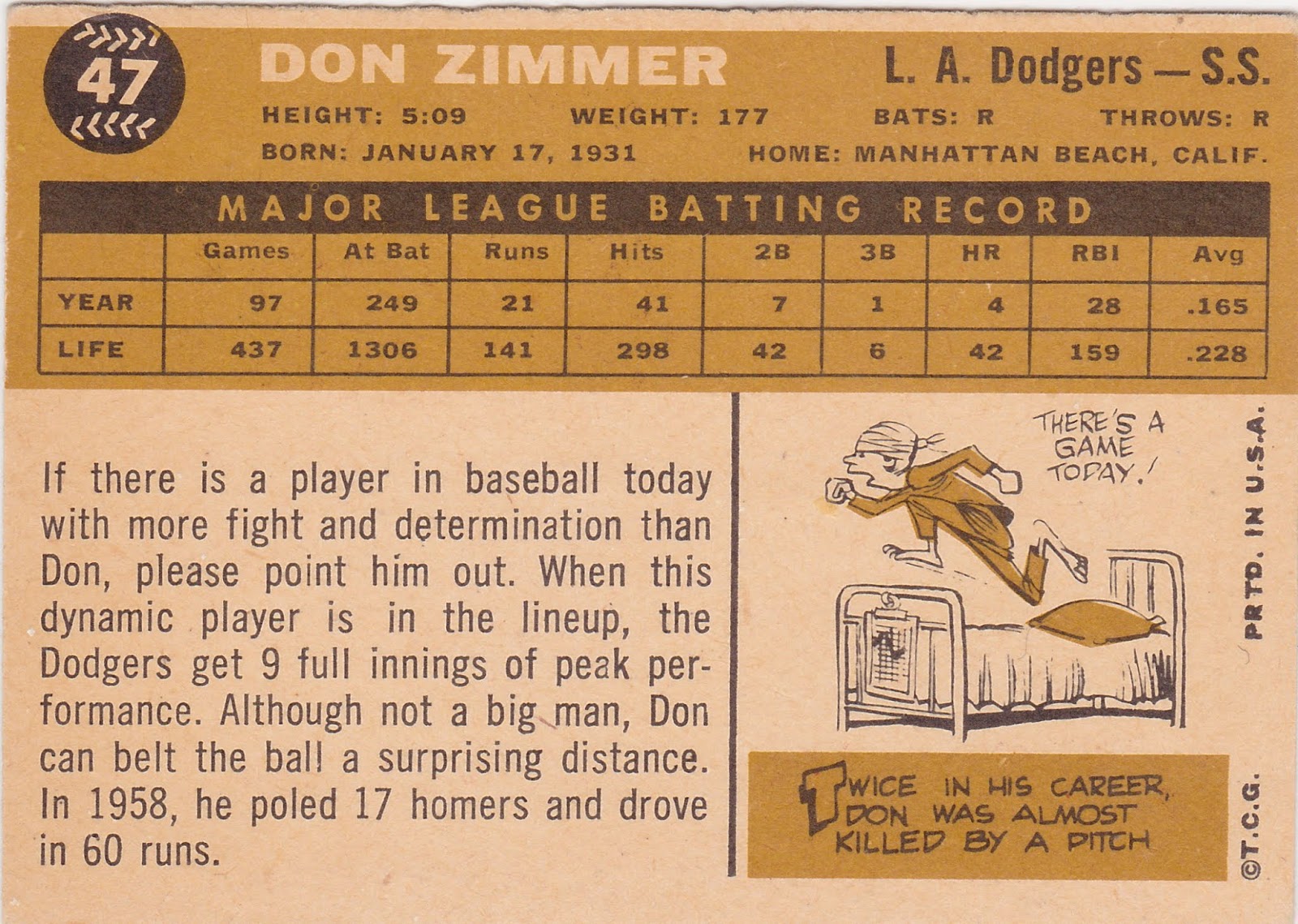
#47 Don Zimmer
Don Zimmer Los Angeles Dodgers
Career: Zimmer is probably the 'baseball lifer'. He said many times that he never drew a paycheck other than from a baseball team. He played a dozen years in the majors, about as many in the minors and Japan. He managed in the majors for 13 seasons and then coached into his 80s. Oh, and he worked as a coach and manager in the minors as well.
In 1960: He had already moved on to the Cubs when this card was issued. He was the regular second baseman on the North Side and hit .258 with six homers. He played one more season with the Cubs and made the 1961 All-Star team.
Off The Charts: Wikipedia sez: During a minor league game on July 7, 1953, Zimmer was struck by a pitch thrown by pitcher Jim Kirk, causing Zimmer to lose consciousness. He suffered a brain injury that required surgery. He woke up two weeks later, thinking that it was the day after the game where the incident took place. This led to Major League Baseball adopting batting helmets as a safety measure to be used by players when at-bat.
The Card: Love the shot of Zim with the Coliseum as the backdrop. I wish I could make out who the player behind him is but the number is unclear. The blurb on the back really sings his praises and the cartoon is one of the better ones and looks (to my eyes at least) to have been done by Jack Davis. Underrated card to be sure!
Subscribe to:
Posts (Atom)