Showing posts with label Boston Red Sox. Show all posts

Thursday, October 29, 2020

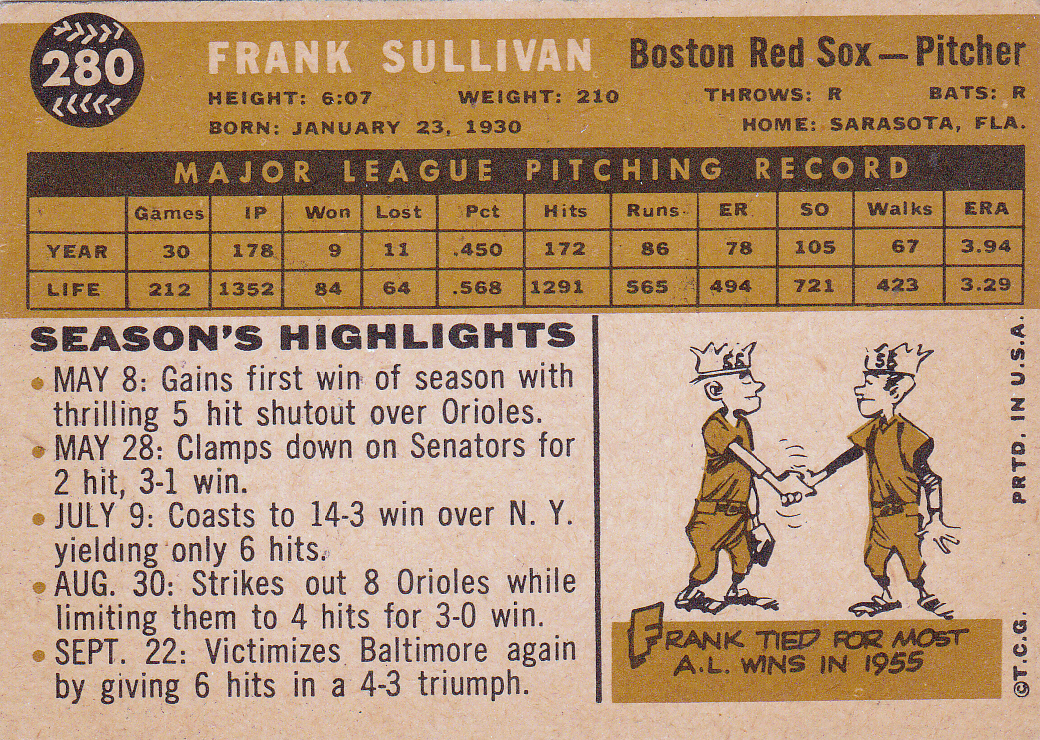
#280 Frank Sullivan


Frank Sullivan  Boston Red Sox

Career: Hollywood native Frank Sullivan had a nice run with the Red Sox in the mid-50s. He won 83 games over six seasons from 1954 through '59 for some less-than-impressive Boston clubs. He was twice and All Star and had a 3.24 ERA in that stretch. He tied Whitey Ford and Bob Lemon for the AL lead with 18 wins in 1955. he was the AL's WHIP leader in 1957 (although nobody then had thought of tabulating that stat).

Sullivan had debuted in Boston in 1953 by pitching rather unimpressively in 14 games. That shot had come after a long minor league stretch and a couple of years in the service during the Korean War. But in '55, as noted above, Sullivan came into his own and had a great run in Fenway. He remained with Boston through 1960 and then wrapped up his career with the Phils and Twins.

In 1960: This was Sullivan's last year for the Red Sox. His numbers dipped significantly from his days as the Sox' 'ace'. His ERA, which had never been above 4.00, ballooned to 5.10 and he lost sixteen against six wins.

Off The Charts: Sullivan's BR Bullpen page tells us..."Frank was the losing pitcher in the 1955 All-Star Game when he gave up Stan Musial's 12th-inning home run. Overall, he pitched creditably after entering in the 8th inning with the score tied, 5-5, and holding the National League scoreless for three plus innings. At the time, the only player in the majors taller than Sullivan was 6' 8" Gene Conley, the game's winning pitcher. Strange but true, after the 1960 season Sullivan was traded to the Philadelphia Phillies for Conley."

Sullivan was the model for one of the players in Norman Rockwell's painting entitled The Rookie. That's Sullivan wearing the #8 in the lockerroom.


Monday, October 5, 2020

#267 Jim Marshall


Jim Marshall  Boston Red Sox

Career: Jim Marshall broke in with the Orioles in 1958 after spending time at Long Beach State, with three different minor league systems and (I'm assuming here) some military service time. In Baltimore he was behind Bob Boyd in the first base pecking order. Marshall was traded during his rookie season to the Cubs and played for the Giants, Mets, and Pirates over five seasons totaling just over 400 games. Despite being listed with Boston on this card he never played for them (see below).

A career .240ish Hitter, Marshall played in the inaugural game for the 1962 Mets, and was the second pinch-hitter called on by Casey Stengel on Opening Day. Three weeks later, with Marshall hitting .344 as a bench piece, he was traded to the Pirates where he ended his playing day later that season.

When his major league career was done Marshall took his bats to Japan and had three successful seasons with the Chunichi Dragons. He displayed the power he had flashed back in AAA ball and was an All-Star.

He was back in the US after that, managed in the Cubs' chain, and had stints as a big-league manager with the Cubs and Athletics. He later scouted the States for the Japanese Leagues, held a job scouting for the Yanks and eventually became the chief scout for the Diamondbacks in the Pacific Rim. At last report, he still holds that job.

In 1960: After being acquired via trade from the Cubs the previous November, Marshall was traded by the Red Sox TWICE before the season even started. They dealt him to the Indians on March 16 along with Sammy White for Russ Nixon. When White refused to report to Cleveland the deal was voided as of March 25th. Four days later Marshall was headed to the Giants for pitcher Al Worthington.

With the Giants, Marshall served as a pinch hitter and filled in at first and in left. He got into 75 games and hit ..237 with a pair of homers over 188 at-bats.

Off The Charts:  Marshall, an Los Angeles area native, was good enough at basketball in high school to receive a scholarship offer from John Wooden at UCLA. He instead played a year of baseball at Long Beach State before he was signed by the White Sox.

Like this snippet from an interview Marshal did a few years back for this blog:

 A trade to the Orioles finally gave Marshall his shot at the majors in 1958 when he was 27 years old.   He roomed with 21-year-old Brooks Robinson that year. "There was never any doubt about his fielding, but he really wasn't a very good hitter back then. We're still friends. In fact, I just talked to him recently. I always tell him, 'I knew you before you could hit.' But he really worked hard on his hitting and he made himself into a very, very good hitter. That's always impressed me. And you have to give [Orioles manager] Paul Richards credit, he stuck with him because he couldn't hit anything at first. Richards could see what Brooks would become."

The Card: Just a bit of his Cubs' cap logo peeking out over the brim in this one.

Thursday, August 13, 2020

#232 Jim Busby


Jim Busby  Boston Red Sox

Career: A multi-sport star at TCU, Jim Busby brokered his speed and decent-enough hitting ability into a 13-season career, mostly in the AL. He had runs with the White Sox (twice), the Senators, Indians, Red Sox and Orioles (twice) in the junior circuit. He capped that with a short run with the Colt 45s in their inaugural 1962 season. Busby covered a lot of outfield ground and led the AL in several defensive categories on multiple occasions.

He made the 1951 All-Star team with the White Sox and was fifth in the AL in hitting in '52 with a .312 average. He was a top ten base stealer for four seasons.

As his playing career wound down he served as a player/coach for the Orioles and the Colt .45s before going into coaching full time. He was frequently on the staff of teams run by fellow north Texan Paul Richards.

One of Busby's sons played for a few years in the Pirates system in addition to helping his father run his citrus grove business. Jim Busby died in 1996 at the age of 69.

In 1960: Busby appeared in the Sox' home opener against the Yankees on April 19. He replaced Ted Williams in left for the top of the ninth. One week later he was released. The Orioles picked him up and he played a month for their AAA club in Miami and was called up in mid-June. He played as their fourth outfielder and a pinch-runner/defensive replacement in nearly 80 games over the rest of the season. He hit .258 in this, his second stint in Charm City.

Off The Charts: Busby's SABR bio notes his great foot speed with this..."In a college track meet he dashed 100 yards in 9.8 seconds, one-half second off the world record at the time. In the majors he was clocked from home to first base in 3.4 seconds, 3/10 of a second slower than Mickey Mantle. Busby tried to promote a match race against Mantle, but the Yankees wouldn’t allow it."

Tuesday, August 11, 2020

#229 Joe Morgan


Joe Morgan  Kansas City Athletics

Career: Topps described Joe Morgan as a 'young star' but in the course of four rather harried seasons he played for five teams and only once had more than 50 trips to the plate. He had been signed by the Boston Braves in 1952 and, after a long climb through the minors and a military detour, he debuted with the Braves in 1959.

After an 'interesting' 1960 season (see below) he played for several years in the minors for a variety of clubs and after an absence of nearly three seasons, got a couple at-bats with the '64 Cardinals.

After managing in the Red Sox chain he was elevated to the dugout job in Fenway Park in 1988 and over four seasons he took the Sox to a pair of AL East titles. His team lost both AL title series in four games to Oakland. Morgan ended his managerial career with a 301-262 record.

In 1960: This was Morgan's busiest season (boy, was it!) as he played in 48 games and got 130 at-bats. Interestingly, he was the property of four clubs over the course of the year. And none of his at-bats came with the team he is shown with, the Athletics. In August of 1959, he had been sold to KC by the Braves. In April of 1960 the A's returned him to Milwaukee. He spent the first few months of the season with the Braves' AAA team before being traded to the Phillies for Al Dark in June. The Phils then sold his contract to Cleveland in August.


Off The Charts: Morgan coached the Pawtucket Red Sox from 1971 to 1982 and was the longest-serving manager in the club’s history. Morgan is the only manager to be inducted into the club’s Hall of Fame, an honor he earned in 2017. In his nine years at the helm, Morgan compiled a franchise-record 601 career wins and is the only person in the history of the International League to win both the league MVP and Manager of the Year awards.

And He Is Really Off The Charts: References to this Joe Morgan are buried so deep in Wikipedia behind the 'other', (Hall Of Famer) Joe Morgan, that I wasn't sure I could do much of a post. How bad is it? Well, if you go to this Morgan's Baseball-Reference page and click the link to his page at the Bullpen Wiki, you are sent to HoF Morgan's info. You have to locate the note at the top that then directs you to this Joe Morgan. Sheesh.

I was able to find that he played hockey as well as baseball at Boston College. The cartoon on the card references his exploits on the ice. Wikipedia reports that he led the Eagles in points his junior year.

Thursday, July 30, 2020

#203 Sammy White


Sammy White  Boston Red Sox

Career: White held down the Red Sox catchers job from 1952 through 1959. He was a career .262 hitter with exceptional skills behind the plate. He had spent three years in the Sox' system before his rookie year when he hit .281 and was third in the AL RoY voting in a very close race with 15-game winner Harry Byrd of the A's and fellow catcher Gus Triandos of the Browns.

White played briefly and sparingly for the Braves and Phils to close out his career in 1961/62. He then ran his bowling center and was a golf pro in Hawaii.

In 1960: He was traded to the Indians in March but rather than report to Cleveland's spring camp, White 'retired', and spent his year at his business. He was talked out of retirement by the Braves the following summer to fill in for an injured Del Crandall.

Off The Charts: White's SABR bio has this to say about his defensive abilities: Casey Stengel, who managed the New York Yankees to six American League pennants and four world championships during White’s tenure as the regular Red Sox catcher, was one of Sammy’s biggest fans. Stengel got to see White in action up to 22 times each year under the old 154-game schedule, and he used to shake his head at Sammy’s ability to “frame” a pitch. “He [White] steals more strikes from umpires than anyone else,” Stengel would tell anyone who would listen. “I’m not being critical,” Stengel would add, “I’m just bowing to his skill.”

Tuesday, July 7, 2020

#186 Dave Sisler


Dave Sisler  Detroit Tigers

Career: A Princeton man, Dave Sisler was the youngest son of Hall of Famer George Sisler and brother of NL first baseman/outfielder Dick Sisler. After one (very successful) minor league season and a couple of years in the military, Sisler broke in with the Red Sox in 1956. His three full years with the Sox were pretty consistent as he hovered around .500 and a 4.75 ERA, mostly as a starter. He got a higher percentage of starting assignments each season. As the card notes, he struggled in 1959 and was traded to the Tigers in May.

He rebounded in Detroit, now pitching exclusively out of the bullpen. But was exposed in the expansion draft and was taken by the Senators. He was in D.C. for a season then traded to the Reds, pitching one final season in the majors and one in AAA in 1963.  He retired with 38 big league wins and became an investment broker.

In 1960: This was his best season statistically. He was 7-5 with five saves, which were not career highs, but his ERA and WHIP were easily better than he had ever posted or ever would.

Off The Charts: His boston.com obit tells us "...Sisler was a three-sport standout in high school in St. Louis, then played basketball and baseball at Princeton University, where he graduated magna cum laude. Toiling for Princeton’s Tigers in 1951, Mr. Sisler posted a microscopic earned-run average of 0.99. He was the last pitcher from Princeton to start a major league game before Chris Young did it for Texas in 2004."


Sunday, July 5, 2020

#148 Carl Yastrzemski Sport Rookie Star


Carl Yastrzemski  Boston Red Sox

Career: He was the son of a Long Island potato farmer who passed along a love of baseball. And he landed in the Hall of Fame after a remarkable career that began with him stepping into the void left by Ted Williams' retirement.

Yaz played for 23 seasons with the Red Sox and had almost 425 at-bats at the age of 43 in his final season. Here is a list of his career highlights from the Baseball-Reference Bullpen:

  • 1959 MVP Carolina League Raleigh Capitals
  • 18-time AL All-Star (1963, 1965-1979, 1982 & 1983)
  • AL MVP (1967)
  • AL Triple Crown (1967)
  • 1970 All-Star Game MVP
  • 7-time AL Gold Glove Winner (1963, 1965, 1967-1969, 1971 & 1977)
  • 3-time AL Batting Average Leader (1963, 1967 & 1968)
  • 5-time AL On-Base Percentage Leader (1963, 1965, 1967, 1968 & 1970)
  • 3-time AL Slugging Percentage Leader (1965, 1967 & 1970)
  • 4-time AL OPS Leader (1965, 1967, 1968 & 1970)
  • 3-time AL Runs Scored Leader (1967, 1970 & 1974)
  • 2-time AL Hits Leader (1963 & 1967)
  • 2-time AL Total Bases Leader (1967 & 1970)
  • 3-time AL Doubles Leader (1963, 1965 & 1966)
  • AL Home Runs Leader (1967)
  • AL RBI Leader (1967)
  • 2-time AL Bases on Balls Leader (1963 & 1968)
  • 20-Home Run Seasons: 8 (1965, 1967-1970, 1976, 1977 & 1979)
  • 30-Home Run Seasons: 3 (1967, 1969 & 1970)
  • 40-Home Run Seasons: 3 (1967, 1969 & 1970)
  • 100 RBI Seasons: 5 (1967, 1969, 1970, 1976 & 1977)
  • 100 Runs Scored Seasons: 2 (1967 & 1970)
  • Baseball Hall of Fame: Class of 1989

What is there to add about this talented, consistent, and durable star?

In 1960:  Yaz was still a year away from his big-league debut. He'd torn up the league in B level ball in 1959, and he did the same when he jumped to AAA in 1960. For the Red Sox' Minneapolis Millers he batted .339 on almost 200 hits including 36 doubles. He only hit seven homers, but he was apparently saving his power for Fenway. He'd played second in his initial season but was moved to the outfield by the organization when he hit AAA.

Off The Charts: Yaz' grandson, Mike, has traveled through a few organizations but in 2019 seemed to find a home in the Giants' outfield and had a nice first big-league season. Last September he homered in his first game ever in Fenway Park. (See below)

A Carl Yastrzemski career highlight film:


The Card: This is one of the more valuable and sought-after cards in the 1960 set, definitely the prize among the rookies. My copy was a modest graded version that I freed from the slab. He's listed as a second baseman, but he was, as noted above, an outfielder in 1960.

It happens to be the last of the Sport Rookie Stars subset (they were alphabetical in the checklist).

Bonus videos...Carl and Mike Yastrzemski homer at Fenway.


Extended coverage of Mike Yaztrzemski's home run last September.


Wednesday, July 1, 2020

#184 Gary Geiger


Gary Geiger  Boston Red Sox

Career: Geiger played for four clubs in a 12-year career but got most of his work during a seven-season hitch with the Red Sox. He had been a Cardinals pitching prospect but was drafted away by the Indians and debuted with Cleveland in 1958 as a speedy outfielder with a touch of power and otherwise average offensive skills. He was traded to the Red Sox and was their regular center fielder for five years beginning in 1959 (when he could stay on the field).  Geiger's career was pockmarked with ulcer problems, concussions, broken bones, and other assorted ailments.

Beginning in 1966 he bounced around from the Braves to the Astros while making several separate appearances in the Cardinals chain. How that all worked I can't say.

In 1960: He missed about half the season due to an operation to correct a collapsed lung. In 77 games he hit .302 and his homer and RBI totals were on track to meet or surpass his career season highs.

Off The Charts: In 1955, deep in the Cardinals' system with Hamilton of the PONY league, Geiger was a 20-game winner on the mound.

Wikipedia reports that Geiger wore false teeth after his own, too soft to take fillings, had all been extracted by age 22.

He died of cirrhosis of the liver at the age of 59. It was likely a result of his drinking habit which he used to overcome his fear of flying during his career.

The Card: The b/w 'action' shot on this card was re-used for his 1962 Topps cards (in color, of course).


Friday, May 15, 2020

#139 Carl Mathias Sport Rookie Star


Carl Mathias   Cleveland Indians

Career: After four fair-to-middling years in the lower minors, Carl Mathias found his game with the Indians' AA Mobile club in 1959. That, and a nice start to the 1960 season in AAA, earned him a look in the Cleveland pen mid-year. He was taken that winter by the Senators in the expansion draft and got generally lit up in four appearances in 1961. That was it for his big league career.

In 1960: He made it into seven games between July 31 and the end of the season. Hard to say if he was up and down between the Indians and AAA or just not used too often. He actually held his own in those seven appearances, 15 innings, 14 hits, and a 3.52 ERA. The rest of the year was split between the Indians and Phillies AAA clubs. How he got involved with the Phils isn't clear. His final tally in the majors showed him losing both of his decisions.

Off The Charts: Mathis was so very close to a big-league win in 1961. It was his first start for the Senators and came in Boston on June 18. He started and was staked to a 7-5 lead going into the ninth. The Nats put what seemed like icing on his cake with five in the top of the inning. Mathias took the mound in the bottom of the ninth leading 12-5. Let's let the game unfold from there courtesy of Baseball-Reference:


If you can't read that I'll tick off the ugly details...

Mathias gets Vic Wertz to groundout to first. Don Buddin singles. Billy Harrell pinch hits for the pitcher and whiffs. So Mathis is an out away from his first (and what would have become only) major league win. A seven-run lead, two outs and a man on. What could go wrong?

A hell of a lot.

Chuck Shilling singles and so does Carroll Hardy.  A run scores but the lead is still 12-6 and we only need an out. But Mathias walks Gary Geiger to load the bases. You'd think this was still a good spot for the Senators. Force anywhere, play back because you're not really worried about having to throw home. Just get a damn out and we can play Game Two for the day. But, no.

Nats' manager Mickey Vernon, watching Mathias in real action for the first time, has seen enough. He brings in his closer, Dave Sisler. Sisler knows how to pitch in Fenway, he had been with the Red Sox for many years. He's got seven saves on the year. Mathias still has to be feeling good. I bet he stayed in the dugout to watch and get the backslaps on his win.

But Sisler walks Jackie Jensen. it's 12-7. Then he walks Frank Malzone, it's 12-8. Up steps Jim Paglaroni, a .230ish hitter who was 0-4 at this point. He has eight career homers.

Make it nine. Pags launched one over the Green Monster and, son-of-a-bitch, we are tied, 12-12. No win for Mathis (who is probably in shock). Vernon is understandably too stupified to make it to the mound for a pitching change and Vic Wertz, who started the inning, walks.

Vernon finally makes a move and brings in Marty Kutyna, but at this point, it doesn't matter. Mathias can't get a win and is probably already having a few beers in the clubhouse. Anyway, Kutyna gives up hits to Don Buddin and pinch-hitter Russ Nixon and that scores Pete Runnels who was running for Wertz. The Red Sox have a 13-12 win. Unbelievable.

BTW...the Red Sox won the second game of the doubleheader in 13 innings. Mickey Vernon did not jump off the roof of the hotel that night. But only because the Nats had a train to catch.

Friday, May 8, 2020

#153 Bobby Thomson


Bobby Thomson  Boston Red Sox

Career: Thomson famously hit the "Shot Heard 'Round The World', the pennant-winning homer off Brooklyn's Ralph Branca in the third game of the 1951 playoff series between the Giants and Dodgers. He's known for that, the most iconic homer in baseball history, but he was a durable, versatile, and dependable player for many years. Playing for the Giants, Braves, and Cubs in the NL and briefly for the Red Sox and Orioles as well, Thomson had 264 homers and a .275 career average. He was a three-time All-Star in a league loaded with All-Star talent in the outfield.

In 1960: This was Thomson's swan song. After being traded to the Red Sox the previous December by the Cubs, he played in 40 games, was hitting .263, and was released on July 1st.  He signed three days later with the Orioles but barely saw the field before being sent on his way at the end of the month. He then went to work as a sales executive in the NY area and spent much of his life re-telling the story of his famous home run.

Off The Charts: Odds and ends from various sources on the web...
  • Willie Mays was the on-deck hitter when Thomson hit that homer off Branca.
  • He hurt his ankle in the spring of 1954 which opened up and opportunity for Hank Aaron to gain a foothold in the Braves' lineup.
  • Thomson and Ralph Branca became close friends in the years following their playoff meeting.
  • The Shot game placed second on ESPN's SportsCentury ranking of the Ten Greatest Games of the 20th Century, behind the 1958 NFL Championship Game. Sports Illustrated ranked Thomson's home run fifteenth on its list of the 100 Greatest Moments in Sports History
On the off chance someone hasn't seen/heard this already, here is a mashup of Russ Hodges' famous call on top of the game video.


Wednesday, April 22, 2020

#117 Tom Borland Sport Rookie Star


Note: I'm breaking my posting pattern to spread out the Sport Magazine Rookie Star cards. I'll say this here and won't repeat it endlessly...this subset holds a special place in the hobby for me. I remember that when I first pulled some from 1960 packs I thought these guys were true immortals! Each destined to be a superstar. Of course, that didn't happen but the design remains, along with the 1958T All-Stars, at the top of my list of great card designs. I loved these then and still do.


Tom Borland Boston Red Sox

Career: After pitching at Oklahoma A&M (now Oklahoma State University) Borland had a couple of impressive minor league seasons in the Boston chain. He debuted with the Sox in 1960 and pitched in 27 games over two seasons. He finished with an 0-4 record. He finished his pro career pitching not far from home for Oklahoma City in the Colt 45s system.

In 1960: He made all but one of his big-league appearances this season between mid-April and August. Borland made four starts and had three saves out of the bullpen and compiled an ERA of  6.53 over 51 innings. He also pitched in five games at the AA level for Boston.

Off The Charts: OSU's athletic site paid tribute to Borland after he passed in 2013 with this...

"[Borland}was inducted into the Cowboy Baseball Hall of Fame in 1998. He helped lead the Aggies to back-to-back College World Series appearances in 1954 and 1955 and was named the CWS Most Valuable Player in 1955."

Thursday, April 16, 2020

#111 Vic Wertz


Vic Wertz  Boston Red Sox

Career: He played 17 seasons in the majors and was a four-time All-Star as well as a four-time Top 10 MVP vote-getter. Yet he is primarily known for one swing of the bat...the drive in the 1954 World Series that Willie Mays nabbed with one of the most memorable catches in baseball history.

He played for five different AL clubs after breaking in as an outfielder with the Tigers in 1947. He had been an outfielder but moved to first base in '54 when he was traded from the Orioles to Cleveland on June 1st of that year. That deal sent him from a terrible first year Orioles club to the eventual AL champions.

In 1960: With his career winding down, Wertz had a very nice last hurrah in Boston. He hit .282 with 19 homers and 103 RBIs in his final season as an everyday player.

Off The Charts: Wertz was 8 for 16 with a dinger in that '54 Series but I bet he'd trade it all for about another foot of height on the shot that Mays caught.

But to his credit he never let it bother him. According to Wikipedia...
After he retired from playing, Wertz kept a photo of “The Catch” in his office at his beer distribution company and explained he had no negative feelings about being remembered for hitting a deep fly out.
"I'm very proud that I'm associated with it," Wertz told UPI in 1979. "I look at it this way: If that ball Willie caught had been a home run or a triple, how many people would've remembered me? Not many. This way, everybody who meets me for the first time always identifies me with Willie's catch, and that makes me feel good."

And to his further credit, he was a big supporter of Special Olympics through his businesses and personal contributions of time and financing.

But because we have to....


Here's a short video of his two-RBI triple in his first World Series at-bat.


Monday, April 13, 2020

#108 Pete Daley


Pete Daley  Kansas City Athletics

Career: Hit .239 in seven seasons in the majors as a platoon and reserve catcher. Came up with the Red Sox and was in Boston for five seasons. Finished up with a year each in K.C. and Washington.

In 1960: This was his only season with the A's. He hit .263 with five homers while splitting time with Harry Chiti and Danny Kravitz. His 273 at-bats were a career-high.

Off The Charts: In his five years with the Red Sox he had a fielding pct. of .996, committing only four errors in over 1,000 chances.

Tuesday, May 28, 2019

#97 Ted Lepcio


Ted Lepcio  Philadelphia Phillies

Career: The bulk of Lepcio's 10-year career came with the Red Sox (1952-1958 + a week or two of '59) and the bulk of THAT time saw him competing for the second base job with Billy Goodman. Once he moved on to the Tigers in '59 kept his bags packed. He spent a year with them, a few games with the White Sox, and nearly a year each with the Phils and the Twins. In 1962 he joined the Mets during their initial Spring Training camp but was released before the season. He finished with 69 homers and a .245 career average and a few 1st place spots in some of the esoteric fielding stat categories that I don't understand (total zone runs?)

In 1960: This was his next-to-last season and he spent it as the Phils' utility infielder getting into almost 70 games and hitting .227 with a pair of homers.

Off The Charts:  Lepcio had been a college star at Seton Hall. Just a year later, as a rookie in 1952, he was Jimmy Piersall's roommate and got a close up look at Piersall's struggles on and off the field.

The Card: After Lepcio's early December '59 trade to the Phils Topps was able to make the card update but used his photo as a Tiger. It's a nice one though, and one of the rare Tiger (Briggs) Stadium shots you'll see from this era of Topps cards. Pink/blue/yellow/white works better than it seems it should! The back hits all the right notes as well.

Tuesday, April 23, 2019

#86 Dick Gernert


Dick Gernert  Chicago Cubs

Career: He played eight seasons for the Boston Red Sox as a 6’3″ first baseman-outfielder and then finished his 11-year career with short stints for the Chicago Cubs, Detroit Tigers, Cincinnati Reds, and Houston Colt .45s. He had a few seasons as the BoSox regular first baseman but more frequently he shared the job. He twice had 20 or more dingers and his .291 in 1956 was a career high. He had four pinch-hit appearances in the 1961 Series with Cincy.  He was a Colt .45s expansion draft pick but was released in May which spared him the misery of the Houston summer and mosquitos.

In 1960: He started the year as a brand new Cubbie but was traded to the Tigers with a month to go in the season. His power numbers were down with just one homer in 160+ trips to the plate.

Off The Charts: Per Wikipedia..."He was involved in the first interleague trade without waivers in baseball history on November 21, 1959, when Boston shipped him to the Cubs for first baseman Jim Marshall and pitcher Dave Hillman"

The Card: Pink is a plus, as is the Yankee Stadium facade. He got a Jack Davis cartoon and the 'last entry is a trade note' treatment. Overall, not a bad card.

Wednesday, April 10, 2019

#79 Walt Dropo


Walt Dropo  Baltimore Orioles

Career: After a three-sport starring role at UConn and an Army stint Walt Dropo exploded into the AL by becoming the 1950 Rookie of the Year with the Red Sox. He wasn't even on the club to start the season. But when he got his call-up he made the most of it by hitting .322 with 34 homers and tying teammate Vern Stephens with 144 RBI for the league lead. He had another fine season in '52 but overall he never could replicate that rookie year. He played 13 years for five clubs and then went into his families' fireworks business.

In 1960: This was his second full season with the Orioles and he got about 180 at-bats but was being pushed aside by rookie star Jim Gentile. He had a decent average (.268) but by the end of May the following season he was out of baseball.

Off The Charts: He was nicknamed 'Moose' for both his size and his hometown of Moosup, Connecticut. He was drafted by the Chicago Bears and the old ABL Providence franchise but chose baseball for both the quick check and his love of the game.

The Card: I like a lot about this one, the colors, the cartoon that references his nickname, and the great portrait shot.

Sunday, March 24, 2019

#71 Marty Keough


Marty Keough  Boston Red Sox

Career: He spent six seasons in the minors and hit well everywhere he stopped but he never could sustain that in the majors. He carved out a long (11 seasons) career as a defensive late-inning replacement and/or fourth outfielder. The only year he approached full-time starter status was in 1961 with the new Washington franchise. He played for the Reds, White Sox, and Braves, Red Sox, Nats, and Indians. He was a scout for the Cardinals until recently.

In 1960: After 38 games and a bit over 100 at-bats, Keough was hitting .248 and maybe in need of a change. In mid-June, he was traded with Ted Bowsfield to the Cleveland Indians for Carroll Hardy and Russ Nixon. Over the rest of the season with the Indians, he hit .248 proving that he was nothing if not consistent. Nixon, meanwhile, hit .298 for the year and solidified the Sox' catching situation. The Indians allowed him to be taken by the Senators in the expansion draft after the season.

Off The Charts: "He comes from a baseball family: he is the older brother of Joe Keough, a former MLB outfielder, and father of Matt Keough, a right-handed pitcher who was a 16-game-winner for Billy Martin's 1980 Oakland A's. Matt also played in Japan, making them one of the few American father-son duos to both play there." -Wikipedia

The Card: The seafoam green isn't really common in this set. It was more popular in Topps' '59 set. Mixed with the orange/black/white...not doing much for me. Nice Comiskey background though. The write-up really sings his praises


Friday, March 22, 2019

#69 Billy Goodman


Billy Goodman  Chicago White Sox

Career: Goodman had a 16-year career which had gone largely under-the-radar given what he accomplished. He played for 11 seasons with the Red Sox and won the 1950 batting title with a .354 mark. He finished second (to Phil Rizzuto) in the MVP voting that year. Overall, in 17 seasons with Boston, the White Sox, Orioles and expansion Colt 45s, he had a career .300 average and played every position except pitcher and catcher. He was twice an All-Star and he picked up MVP votes in six seasons. He had three hits and an RBI in the 1959 Series. 

In 1960: His career was beginning to wind down and he was little used by Al Lopez in '60 as he got only 77 at-bats. He was left available in the AL expansion draft after the season but went undrafted.

Off The Charts: After his big league days he became the player/manager of the Durham Bulls and pitched a bit for them. That meant that the only position he hadn't played as a pro was catcher.

The Card: Classic White Sox card with Goodman sporting that cap with the red-outlined lettering (I love that one) and the TV sleeve numbers. He's at Yankee Stadium and the card has a sweet color combo. And, hey, howdy, hey...he's wearing a cap!

Thursday, March 21, 2019

#68 Dave Hillman


Dave Hillman   Boston Red Sox

Career: He was an Air Force vet playing weekend ball when the Cubs signed him. He had outstanding minor league seasons which he could never replicate in the bigs. His 8 wins in 1959 were a career high but not enough to prevent him from being traded to Boston. Overall he won 21 games spread over parts of eight seasons. In 1962 he had been traded from Boston to the Reds who, after two shaky games, returned him to the Red Sox. The Sox dealt him to the fledgling Mets and he finished his career there that season. 

In 1960: Hillman spent long stretches on the DL beginning in spring training and ended up only pitching 36 (very rocky) innings that year.

Off The Charts: His sporadic use in 1960 first came as the result of a car wreck which is detailed in his SABR bio:

His Red Sox career almost ended before it began. A spring training headline out of Scottsdale read: “Hillman Career May Be Ended By Car Injuries.” Early in the morning of March 10, the automobile Marty Keough was driving reportedly hit a soft shoulder and rolled over five times before coming to a stop. The AP report said the accident occurred at 1:15 AM but the two players claimed it happened at 12:35 AM and that they would have otherwise made it back to the Safari Hotel before the 1:00 AM curfew. They were traveling 70 mph in a 45-mph zone, and the car was demolished after skidding over 600 feet and landing on its roof. Keough was shaken up, but Hillman required seven stitches in his head and badly bruised his right shoulder. Manager Billy Jurges chose not to penalize them. Hillman showed up later that day, his arm in a sling.7 He returned to action on April 16.

The Card: Yet another capless player, the fourth in a row to be posted. At least Topps had a reason for Hillman's pic. He had been traded by the Cubs to the Red Sox over the winter. And there's a bit of irony here with the cartoon showing 'Hillman' and an RC policeman given his 1960 wreck. Bonus points for the transaction being listed as a highlight bullet point. 

Tuesday, February 26, 2019

#54 Mike Fornieles


Mike Fornieles  Boston Red Sox

Career: He's a native of Havana, Cuba and was one of many Cuban players signed by Senators' scout 'Papa' Joe Cambria. Ha had a terrific first year stateside in 'B' ball and was impressive in a late look in Washington but was traded to the White Sox after that first year. He was an occasional started early in his career but was primarily a reliever for four clubs over twelve seasons. His best years came with the Red Sox. He made the All-Star team in 1961 and pitched to three batters: George Altman (homer), Willie Mays (fly out) and Frank Robinson (single).

In 1960: Arguably his best season as he led the AL in appearances and was second in saves to go with a 10-5 record and a 2.64 ERA. He won the first The Sporting News Fireman of the Year Award in the AL.

Off The Charts: His SABR bio is pretty entertaining and tells us that: "With Washington scheduled for a doubleheader against the Philadelphia A’s on September 2, 1952, the Senators decided to promote a pitcher from the minor leagues and called down to Havana for Raul Sanchez, a right-hander with a 10-9 record. Many players need some degree of luck to get their first opportunity in the majors and Fornieles was one of those. Sanchez was too sick to report, so Havana sent up Fornieles instead and Washington gave the 20-year-old the start in the second game of the doubleheader.'

'...He turned in one of the best pitching debuts in major-league history, throwing a one-hit shutout in a 5-0 victory, allowing only a second-inning single to catcher Joe Astroth and retiring the last 14 batters in order."


The Card: Bonus points for a pink section! It's not a stretch to assume this pic was taken at the same session in Yankee Stadium as the pic used on his 1959 card. I blew them up and the same people appear in the background (or so it seems).