Showing posts with label Yankee Stadium. Show all posts

Saturday, October 31, 2020

#281 Ray Boone


Ray Boone  Milwaukee Braves

Career: Ray Boone is the patriarch of baseball's first four generation professional family*, the first family to send three generations to the All Star Game. Boone played in the majors for thirteen seasons beginning in late 1948 when he got a quick peek at Municipal Stadium in Cleveland. He played primarily for the Indians and Tigers as an infielder and was a two-time All-Star with Detroit in the mid-fifties. 

Boone, a WWII vet who served nearly four years in the Navy, led the AL in RBI in 1955 and picked up MVP votes in three seasons. He was a career .275 hitter and homered off Robin Roberts in the 1954 All Star Game. After his playing days Boone was a longtime scout for the Red Sox.

In 1960: He opened the season with the Braves but was dealt to the Red Sox in May. He hit just .205 overall in 90 at-bats combined. The Sox released Boone in September and his playing days were over.

Off The Charts: Wikipedia tells us that he was a descendant of American pioneer Daniel Boone.

The Card: I'm 99.99999% sure that the photo was taken in Yankee Stadium. And I'm also 99.99999% sure that Boone is not wearing a Braves beanie in the action pic despite the best work of the Topps artist to make it look like he is.

*=Jake Boone, Ray's great-grandson, has been drafted twice by the Nats, signed with them but has yet to play in the minors due to the cancelled season.

Wednesday, September 23, 2020

#262 Hank Bauer


Hank Bauer  Kansas City Athletics

Career: Bauer, whose reputation as a tough ex-Marine is widely known, had a 14-year playing career, twelve of those seasons were with the Yankees. His career peaked with the powerhouse early-to-mid 50s Yankees clubs and Bauer was an All-Star from 1952 through 1955. He picked up MVP votes in five straight years beginning in 1952 as well.

Bauer played in nine World Series with the Yanks, winning seven including five straight from 1949 to 1953. He is sixth on the list of World Series at-bats and hit seven Series homers including four in the '57 Series. The card's cartoon mentions the fact that Bauer holds the record for hits in consecutive World Series games. He still holds the record. His streak included 1956 WS games 1-7, 1957 WS games 1-7, and 1958 WS games 1-3. warren Spahn's two-hit shutout of the Yanks in Game Four of the '58 Classic ended Bauer's run. He got the last laugh though, as he homered off Spahn in his first at-bat in Game Six and he got his ring in the end.

He finished his career with the Athletics in '60/'61. He was the As' player/manager for part of his final active season.

Bauer managed the A's in both KC & Oakland, as well as the Orioles and he won another ring when the '66 Birds swept the Dodgers.

There is a lot more to the Hank Bauer story than I can include here so I'll point you to his SABR bio for a long but entertaining read.


In 1960:
Bauer came to the Athletics in the December '59 trade that sent Roger Maris to the Yankees. He got into 95 games and hit a respectable .275 which is right about his career average.

Off The Charts: Bauer's WWII Marine story as told by Wikipedia...
One month after the Japanese attack on Pearl Harbor, Bauer enlisted in the U.S. Marine Corps and served with the 4th Raider Battalion and G Company, 2nd Battalion, 4th Marines. While deployed to the Pacific Theater, Bauer contracted malaria on Guadalcanal, however he recovered from that well enough to earn 11 campaign ribbons, two Bronze Stars, two Purple Hearts (for being wounded in action) in 32 months of combat and the Navy Commendation Medal. Bauer was wounded his second time during the Battle of Okinawa, when he was a sergeant in command of a platoon of 64 Marines. Only six of the 64 Marines survived the Japanese counterattack, and Bauer was wounded by shrapnel in his thigh. His wounds were severe enough to send him back to the United States to recuperate.
Hanks's next-to-last career homer was an inside-the-park job off his pal, Whitey Ford in June of 1961 at Yankee Stadium. I bet they laughed about that one over beers a time or two. Baseball-Reference's home run log says it was hit to 'deep' centerfield. In Yankee Stadium that likely means it rolled to the monuments.

The Card: Topps had their artist paint the A's logo on to Bauer's cap but so little of it is visible on the color shot you wonder why they bothered.

Sunday, September 20, 2020

#260 Power Plus


Power Plus (Rocky Colavito and Tito Francona   Cleveland Indians)

The happy couple posed at Yankee Stadium for this Topps Special.

This card was probably a painful one for Cleveland fans in 1960. In April, on the eve of Opening Day, Rocky Colavito, the 1959 AL home run champ and an immensely popular figure in the city, was traded to the Tigers for the defending AL batting champ Harvey Kuenn.

Cleveland.com has the story (as do about 500 other online sites). The deal was huge at the time. Even I remember the stir it caused in baseball.

Colavito's 1960 season in Detroit wasn't up to par for him but he bounced back in a big way in 1961. Meanwhile, Kuenn hit .308 for the Indians. That was well off his .353 of 1959 but he did make the All-Star team. What I hadn't realized until I was doing some poking around for this post was the season opener for both teams...yup, you guessed it...was the Indians in Tiger Stadium. I bet that was a fun day for Frank Lane.

Tito Francona, Terry's father, had a solid season. His .292 average was below his ..363 of 1959 (when he was fifth in MVP votes) but he had another .300 year just around the corner in 1961 when he also made his only All-Star team.

On a side note...Francona was flirting with .400 through most of the summer of 1959. He'd forced his way into the Indians' lineup with a super hot bat. His average, as the card back notes, was 10 points higher than Kuenn's but he lacked having quite enough at-bats to qualify for the batting crown.


Monday, June 15, 2020

#140 Julio Navarro Sport Rookie Star


Julio Navarro  San Francisco Giants

Career: The New York Giants signed Julio Navarro out of Puerto Rico in 1955. He pitched exceptionally well in their system waiting for a shot that didn't come. The Giants dealt him to the Angels on September 2, 1962 and the very next day he was on the mound in a game at Yankee Stadium. He pitched three innings in a win for the Angels and was back out there the net day to record his first win with another relief appearance.

He had a 12 save season in 1963, his best overall campaign. He was traded to Detroit in April of '64 but never put together another good season. He returned to the minors and was a starter in the Braves system for a number of years and made a final big league cameo in 1970.

In 1960:  Navarro spent the season in AAA with teams affiliated with both the Giants and the Orioles. I have no idea how that stuff worked. He went 5-12. Most of his 1960 stats for that year (and the next) are not recorded on Baseball-Reference.
Off The Charts: He's the father of Jaime Navarro who had a 12-year career as a starting pitcher with the Brewers, Cubs, White Sox, and, for a few games, Indians. Jaime won 116 big league games, 109 more than his Pops. The Navarros were the first father and son to each record a major league save.


Monday, May 20, 2019

#89 Hal Brown


Hal Brown  Baltimore Orioles

Career: The bulk of his 14-year major league career came with the Orioles. He began in the Red Sox chain but came under the wing of Paul Richards in Seattle and he followed Richards to Chicago to make his debut. The knuckleballer was traded to Boston and then and later to the Orioles where he was reunited with Richards. He was primarily a starter but worked quite a bit out of the bullpen over the years. He finished his career with two games as a Yankee and a couple of seasons as a Colt .45 in Houston.

In 1960: He was the vet among the Baby Birds staff that featured four others aged 22 or under. He had 12 wins (a career high) and just five losses in 20 starts (30 appearances overall). His WHIP led the league although nobody would have known that stat had you asked around back then. He easily had the best K/W ratio on the staff fanning three hitters for each walk allowed. 

Off The Charts: From his SABR bio... In early 1943 he learned that he was about to be drafted, so he enlisted in the Army Air Force. He served as a gunner on bombers based in England. During one attack on Nazi submarine bases in France, his plane took heavy fire. “We got hit and didn’t make it back to England,” Brown said. “We had to bail out. They picked us up after a few hours in the (English) Channel."

The Card: Great color combo, old school logo, Yankee Stadium photo, highlights list and cartoon.  What a 1960card should be.

Thursday, May 16, 2019

#87 John Romanowski


John Romonosky  Washington Senators

Career: Romonosky pitched in 32 major league games, debuting with two starts in 1953 for the Cardinals. After two years in the service, he re-emerged with the Senators in 1958 and pitched in parts of that season and the next. He had a career mark of 3-4 in just over 100 innings. He finished his career in the minors in 1961.

In 1960: He was released by the Senators in April. about the time this card was being found in packs. He spent 1960 in the Yankees organization at the AAA and then AA levels.

Off The Charts: There is (was?) a high school pitching award named for him given out by a Central Ohio baseball booster organization.

The Card: This is one of two Topps card he had, the other being his 'rookie' card in the 1959 set. Another Yankee Stadium photo, this time with some early arriving fans (or reporters) populating the background. A pleasant color combo on this one.

Sunday, April 14, 2019

#83 Tony Kubek


Tony Kubek  New York Yankees

Career: Tony Kubek was the AL Rookie of the Year for the Yankees in 1957 and he played for nine big league seasons, all in NY. He was a three-time All-Star and won three rings in six World Series shots with the Yanks. He received much notoriety when a bad-hop grounder off the bat of Bill Virdon in the 7th game of the 1960 Series struck him in the throat allowing Virdon to reach and the Pirates to rally and win on Mazeroski's famous dinger.  He retired at 29 due to a neck injury that threatened to cause permanent damage. He spent almost 30 years as a broadcaster for the Jays, Yanks, and NBC.

In 1960: He had comparable numbers to his All-Star seasons but didn't get the nod. His 14 homers were a career high.

Off The Charts: From Wikipedia...In Game 3 of the 1957 World Series, he had one of the best World Series games a rookie has ever had, going 3 for 5 with two home runs, three runs scored, and four RBI.

The Card: A pink element and highlights bullet list are plusses.

Friday, March 8, 2019

#57 Win-Savers


Turk Lown - Gerry Staley

In 1960: Following up on their AL title season that is documented in the card's text, these two relievers had solid years. Staley went 13-8 over 64 relief appearances with 10 saves while Lown added five saves.


The Card: A lot of these combo shots from vintage Topps sets feel like they were included just because they had a picture sitting around. This one had some reasoning behind it. Staley and Lown were a valuable 1-2 punch for Al Lopez in 1959.

Nice Yankee Stadium shot. #20 in the background Johnny Romano. He was the only White Sox player to wear that number in 1958/59, the two years that Lown and Staley were there prior to the card being issued.

The back is seriously mis-cut. But that sure isn't enough to warrant an upgrade.

Friday, October 14, 2016

#365 Minnie Minoso


Minnie Minoso  Chicago White Sox

Career: Minoso began his pro career with the New York Cubans of the Negro Leagues in 1946. He finished with a cameo at the age of 77 as a member of the independent St. Paul Saints in 2003. In between he spent 17 seasons in the majors winning three Gold Gloves, being named to 7 All Star squads, finishing second in the 1951 ROY balloting and four times finishing in the top five in MVP votes. He led the A.L. at various times in hits, doubles, triples, hit by pitches (many times) and sac flys.  He was a player/manager in Mexico for quite awhile in the '60s and '70s.

In 1960: This was his first season back with Chicago after having spent seven years with the from 1951 thru 1957. He made the All Star team and led the A.L. with 184 hits. He hit 20 homers and drove in 105 runs.

WikiFacts: From his Wikipedia page: "Miñoso's White Sox uniform number 9 was retired in 1983, and a statue of him was unveiled at U.S. Cellular Field in 2004. Miñoso was elected to the Cuban Baseball Hall of Fame in Exile in 1983, and to the Mexican Professional Baseball Hall of Fame in 1996."

The Card: Looks like Topps tried to replicate the White Sox jerseys by putting their sleeve number over the Chief Wahoo logo on the sleeve. But the Sox wore the number on the other sleeve.  They get points for trying though.

Monday, February 29, 2016

#296 Nelson Chittum


Nelson Chittum  Boston Red Sox

Career: He pitched in 40 big league games, all but two in relief, for the Cardinals and Red Sox between 1958 and 1960. His career mark was 3-1 with a 1.35 WHIP. Chittum had outstanding numbers as he moved up the Cardinals' chain from 1956 through 1958. But his brief tenure in St. Louis was not impressive and he was traded to Boston, His three 1959 wins and solid numbers in limited duty in '59 likely earned him a spot in this set.

In 1960: Chittum opened the season with the Sox but was dealt to the Dodgers for Rip Repulski early in May. He was sent to Omaha (AA) by the Dodgers and never again reached the majors. He finished with a couple of seasons in the Orioles system.

WikiFacts: From his SABR bio:
Chitttum once described his pitching style: "I threw everything but the ball. I'd throw 'em the arm, the elbow, the glove, and then I'd throw the ball…I had a good sinker, a good slider, good location. I didn't walk anybody, didn't strike out many guys but kept the ball down, made 'em hit ground balls, pop flies."

The Card: Not a bad card of a not very well known player. The addition of orange to the fairly common yellow/red/black scheme is actually nice.

The Red Sox made two trips to Yankee Stadium after Chittum was called up by the Sox in August of 1959. Topps was there to snap this shot.

Wednesday, December 23, 2015

#81 Russ Snyder


Russ Snyder  Kansas City Athletics

Career: Snyder was an outfielder in the Yankees' chain for six seasons during the Fifties. He hit in the .280s for the most part which wasn't going to be good enough to squeeze himself onto the loaded Yanks' roster. He was dealt to Kansas City in 1958 and a year later debuted with the A's. He finished third in the '59 Rookie of the Year balloting before slumping in 1960 and being shipped to Baltimore. He spent seven years with the Orioles (the bulk of his career) and was a valuable starter and fourth outfielder for most of that time. He hit .306, contributed with his glove and won a ring with the O's in 1966.
He finished his career in 1970 after stops with the White Sox, Indians and Brewers. He retired to his native Nebraska and still lives there.

In 1960: He suffered from the dreaded 'sophomore jinx' and saw his average fall fifty points from his .313 mark as a rookie. With sixty more at bats he couldn't push the needle much higher (one more homer, five more RBI) and he was off to the Orioles after the season.

WikiFacts: Baltimore Sun interview in 2013: A slap-hitting, sharp-fielding outfielder, Snyder batted .306 for the World Series champion Orioles that year. He led the American League in hitting (.347) at the All-Star break.

His glove served the team down the stretch. On Sept. 22, in a victory over Kansas City, Snyder's diving catch of a line drive finished off the Athletics and clinched the Orioles' first pennant. And in the World Series opener in Los Angeles — a 5-2 victory — he scored the game's first run, singled in another and saved two Dodgers' runs in the second inning with a dramatic lunging catch of John Roseboro's sinking liner.

Forty-seven years later, Snyder recalled his desperation in running down that shot in center field.

"When the ball was hit, I just took off," he said from his home in Nelson, Neb. "The closer I got, the more I thought I could catch it. I dove and … well, that really was one of the turning points of the Series."

Tony L. recently profiled Snyder over on his 'Off Hiatus Baseball Cards' blog. Check it out.

The Card: There are more than a few cards with pink elements scattered through the 1960 set. And they are among my favorites. Add in the cream cardboard and highlights back and it's a 'keeper'. That appears to be Yankee Stadium for those keeping score

Saturday, August 22, 2015

#346 J.C. Martin


J.C. Martin  Chicago White Sox (Uncorrected error-That's Gary Peters pictured)

Career: He was originally an infielder/outfielder. After a couple of late season appearances Martin made the transition to catching and stuck on the Sox roster in 1961. He ended up playing nearly as much as starter Sherm Lollar. He was back in the minors for most of '62 and then served as the White Sox on again/off again starter for five seasons. He shared duties with John Romano for much of that time. He played for the Mets for a couple of seasons and won a championship with them in 1969. He got a pinch hit in his one playoff at-bat that year and was involved in a controversial play in the World Series (see below). And then it was back to Chicago and three years of spot duty with the Cubs. He remained in Chicago as a coach for the Cubs and TV analyst for the Sox.

In 1960: Martin had a nice season for San Diego in the PCL before he was called up to the White Sox in September. He got 20 at bats in seven games and picked up a pair of hits.

WikiFacts: "In Game Four of [the 1969] Series, his Mets leading two games to one, Martin was involved in a controversial play. With the game tied 1–1 in the bottom of the 10th and pinch-runner Rod Gaspar on second, Martin, again pinch-hitting for Seaver, bunted to the mound and, while running to first, was hit on the arm by Pete Richert’s errant throw, the error allowing Gaspar to score the winning run. Replays later showed that Martin had been running inside the baseline, which could have resulted in him being called out for interference. The umpires said they did not make the call, however, because they felt Martin did not intentionally interfere with the play. As a result of this play, the running lane that extends from halfway down the first-base line to the bag was added to all major league fields. A runner can be running in this lane and be hit by a thrown ball and not be called for interference."  -Wikipedia


The Card: I assumed Martin was always a catcher. The card showed me otherwise. This is one of the better color combos. . The Sox' fantastic 'flying sock' logo matches the lettering nicely. It was interference, dammit.

As noted in the intro Gary Peters picture was used for this card. J.C. Martin's photo was used on Peters' card. The error was not corrected.

Sunday, August 16, 2015

#317 Pumpsie Green Topps All Star Rookie


Pumpsie Green  Boston Red Sox

Career: The Red Sox were the last team to integrate and Pumpsie Green was the one to do it. He debuted in late July of 1959. Pitcher Earl Wilson followed about a week later. Green and Wilson became the first African-Amercans to take the field in Red Sox uniforms at Fenway on August 4th (Green) and 5th (Wilson).

Green played for Boston through the 1962 season as a utility infielder. He finished his major league career with a '63 stint as a New York Met. Bracketing his big league days were many years in the minors. He hit .246 for his career with 13 homers.

In 1960: This was Green's first full season and it was his busiest. He got into 133 games and had just over 300 plate appearances hitting 3/21/.242/.350.

WikiFacts: Green's SABR bio is well worth the read. It's an interesting look at a guy who wasn't trying to be a pioneer, just a ballplayer. And as a sidelight there is this strange story:
The biggest headlines Green earned in 1962 were when he and Gene Conley went AWOL, walking off the team bus as it was stuck in heavy New York traffic. It was July 26, and the team had just lost to the Yankees, 13-3, and the players were hot. They thought they might get a drink, and seem to have “done the town in style.” Conley apparently also tried to talk Pumpsie into going to Bethlehem with him “to be nearer to God.” Pumpsie preferred rejoining the team in Washington and turned up a little more than 24 hours later. Conley returned on the 29th. Pumpsie appeared in 56 games (fielding in only 23 of them), hitting .231 in 91 at-bats. He drove in 11 runs.
The Card: The subsets in the 1960 Topps set are all pretty sharp. That's Yankee Stadium behind Pumpsie. But it's the right field line which doesn't get the exposure that the left field side does in Topps cards. He doesn't look happy but any card with the Rookie Trophy automatically gets bonus points.

Monday, August 10, 2015

#405 Bobby Richardson


Bobby Richardson  New York Yankees

Career: Richardson played his entire career with the Yankees. He broke in with brief stints in 1955 and 1956 before establishing himself as a starter (and All Star) in '57. He twice hit over .300 and is one of only four players to have 11 or more hits in two different World Series. He appeared in seven World Series with the Yanks, winning three. He was a seven time AL All Star, won five Gold Gloves and was second in the 1962 MVP voting.

In 1960:  Richardson had one of his worst years at the plate during the regular season but his .367 average and 12 RBI in the Yanks title win over the Giants earned him the Series MVP.

WikiFacts: "In his playing career and his life, Bobby Richardson cast a longer shadow than his 5'9" frame might suggest. He was a good hitter and a marvelous set-up man for one of the most famous slugging duos in baseball history. He was an excellent fielder for a team loaded with groundball-inducing pitchers. Above all, he was a member of the New York Yankee family during one of their most golden eras, and he was proud of it. Famously, Mickey Mantle's widow, Merlyn, asked "the Preacher" to deliver the eulogy at Mickey's funeral service in 1995. The Mantles were at Roger Maris' funeral ten years earlier when Bobby recited a poem that a fan sent him, and Mickey made Richardson promise that he would read it at Mickey's funeral, too." -Richardson's SABR bio

The Card: It's very much miscut...I picked it up in that condition to counteract the "Yankee Tax" you pay for cards of the Bombers from this era. I like it a lot though, as I do any card with the Yankee Stadium scoreboard in the background.


Friday, June 12, 2015

#283 John Blanchard


John Blanchard, New York Yankees

Career: Blanchard spent eight seasons in the majors, the vast majority as a platoon catcher, pinch hitter and spare outfielder with the Yankees. He won World Series rings with the Bombers in 1961 and 1962. His personal 'triple crown' came in 1961 when he hit 21 homers with 54 RBI and a .305 average in 243 at bats.

In 1960: He was still a spare part in his second full season in New York. He appeared in 53 games, had about a hundred plate appearances and hit .242 but he did go 5 for 11 with two doubles in the Series against the Pirates.

WikiFacts: "Blanchard appeared in the World Series 5 times for the Yankees and holds the Major League record with ten World Series pinch-hit at-bats. Blanchard was the catcher who called the pitch that Bill Mazeroski hit for the first-ever series ending home run off Ralph Terry in the 1960 World Series in which the Pittsburgh Pirates defeated the heavily favored Yankees." -SABR bio

The Card: This one features one of the better color combos and a posed, waist up shot which breaks up a long string of 'mug shots' in this set. The iconic Yankee Stadium facade brings back a lot of memories. Blanchard didn't have many highlights in 1959 so he gets a bio blurb instead of the bullet-ed list. I think he borrowed Elmer Fudd's coat for his cartoon pose.

Sunday, June 7, 2015

#535 Whitey Lockman


Whitey Lockman, Cincinnati Reds

Career: Lockman spent 13 years with the Giants, first as an outfielder and then moving to first. Between 1948 and 1955 he was one of the Giants better hitters with double digit homers most seasons and an average running close to .300. He took and interesting detour to the Cardinals in a June trade to St. Louis in 1956. He was traded back to the Giants following that season.

He coached, managed (the Cubs in the early 70s) and held front office jobs after his playing career before finally retiring from the game after nearly 60 years in it.

In 1960: He'd come over from the Orioles in mid-summer of 1959 and he was released by the Reds in June of 1960 after just a handful of at bats to that point. He immediately joined the clubs' coaching staff.

WikiFacts: "Lockman, who played primarily for the New York Giants, was on second base when Bobby Thomson hit possibly the most famous home run in history, the ninth-inning “Shot Heard ‘Round The World” that won the pennant for the Giants in a 1951 playoff game with the Brooklyn Dodgers.

Lockman grew up in the Paw Creek area on the outskirts of west Charlotte. He played his first major league game in 1945 with the Giants, homering in his first at-bat while still just 18 years old." -from his obit in the Charlotte Observer

The Card: Whitey looks very happy in this shot taken at Yankee Stadium. He's in Orioles duds, you can tell by the piping and the Orioles cap on the player in the background. The write-up makes note of his serving on the Reds' staff in the spring.

Saturday, May 30, 2015

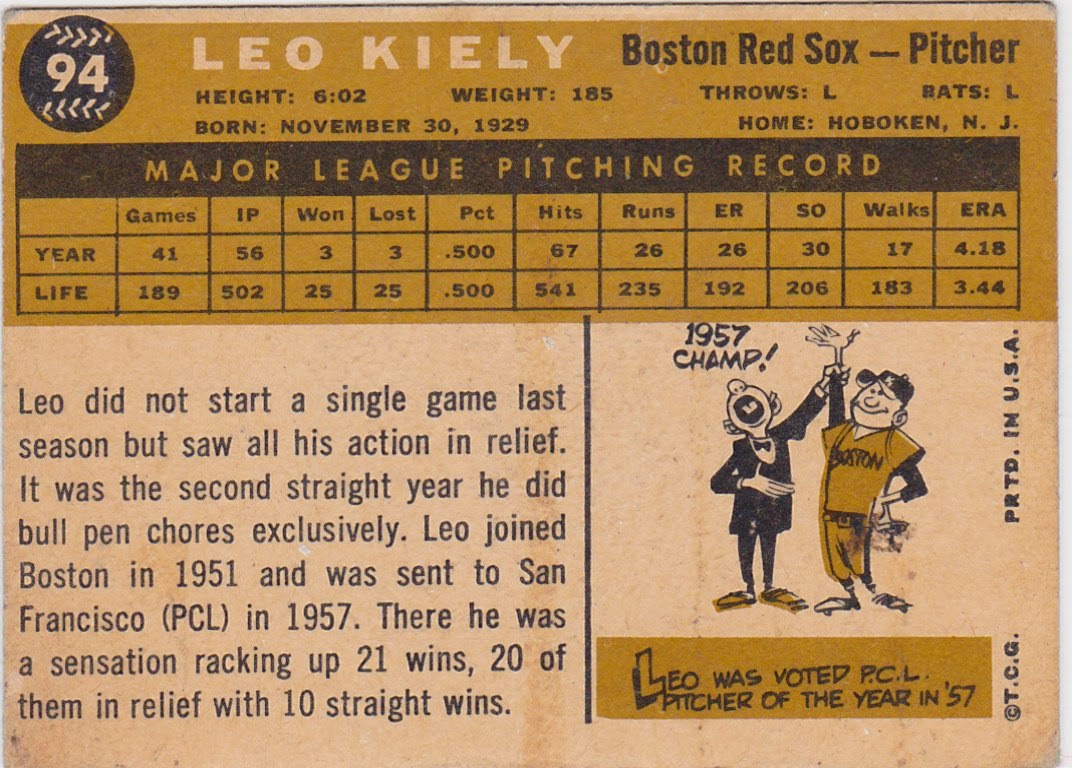
#94 Leo Kiely


Leo Kiely, Boston Red Sox

Career: Kiely went 7-7 in his rookie year of 1951 and then had his career interrupted by a stint in the military. He pitched in Japan in 1953 and later returned stateside to resume his major league career. After 1954 he bacame a full time reliever and was third in the AL in saves in 1958 with 12. His most successful year came while pitching in the PCL in 1957. That year he won 21 games, 20 of them out of the bullpen.

In 1960: Kiely was actually a member of the Kansas City Athletics in 1960 having been dealt twice over the winter. The BoSox sent him to the Indians in January and he was traded again, to the A's this time, just before Opening Day.

In KC he made 20 appearances up through June 20th. All were in relief and most were very good. He allowed only 4 earned runs in 21 innings. After his third blown save he disappeared from the majors. He was suffering from a sore elbow and had surgery to remove bone chips but never pitched again.

WikiFacts: From his SABR bio: Frank Sullivan, a keen observer of his surroundings, described Kiely’s penchant for beer: “He was one of the all-time beer drinkers. Never loud, never out of hand, he could sit quietly and drink you into oblivion. I continually marveled at the way he would pour each bottle of beer slowly and deliberately into a small glass and savor each sip as if it were the first of the day. I believe he was made up of 98% liquid. After five warm-up pitches he would literally be dripping sweat from the bill of his cap. His personality was as even-keeled as anyone I had ever met; he had absolutely no enemies. I counted him as one of my best pals on the team. Leo was one of the sweetest guys I ever met. There wasn't a bad bone in his skinny body."

The Card: My copy is a bit faded with soft corners and it's miscut. In other words..it's perfect for my needs. That's Yankee Stadium and I've seen enough of that usher in the stands over Kiely's shoulder  on other cards in the '59 and '60 sets to think of him as a family friend.

Thursday, May 14, 2015

#546 Hank Aguirre


Hank Aguirre, Detroit Tigers

Career: In his 16 year career Aguirre spent four seasons as a starter for the Tigers and two others in which he split time about equally between the rotation and the pen. The rest of the time, including seasons with the Indians, Cubs and Dodgers, he was a bullpen fixture. He won 75 games and had 33 saves. His best season was 1962 when he won 16 games and led the AL in ERA, ERA+, WHIP and made the All Star team. He pitched three innings in the second of two ASGs that year and got a 'hold'.

In 1960: He went 5-3 in 37 games including six starts. He posted a 2.27 ERA and a career best 2.67 k/w ratio.

WikiFacts: One of the worst hitting pitchers of all time Aguirre got one at bat in that 1962 ASG. Juan Marichal whiffed him. he had one career triple. It came in a game at Yankee Stadium which I witnessed. I detailed that day in my post of Aguirre's 1959 card.

Notable Achievements:

AL All-Star (1962)
AL ERA Leader (1962)
15 Wins Seasons: 1 (1962)
200 Innings Pitched Seasons: 3 (1962, 1963 & 1965)

The Card: Red, blue, yellow and white is a nice combo on these cards. This was part of my initial large lot purchase. It's typical of the condition of the cards I got, a bit closer to 'good' than 'fair'.

I'm partial to this card because of my 'connection' to Aguirre. He probably had that same grin on his face as he stood on third base that day in Yankee Stadium. Those same stands were behind him at that moment that day as well.