Saturday, October 31, 2020

#281 Ray Boone


Ray Boone  Milwaukee Braves

Career: Ray Boone is the patriarch of baseball's first four generation professional family*, the first family to send three generations to the All Star Game. Boone played in the majors for thirteen seasons beginning in late 1948 when he got a quick peek at Municipal Stadium in Cleveland. He played primarily for the Indians and Tigers as an infielder and was a two-time All-Star with Detroit in the mid-fifties. 

Boone, a WWII vet who served nearly four years in the Navy, led the AL in RBI in 1955 and picked up MVP votes in three seasons. He was a career .275 hitter and homered off Robin Roberts in the 1954 All Star Game. After his playing days Boone was a longtime scout for the Red Sox.

In 1960: He opened the season with the Braves but was dealt to the Red Sox in May. He hit just .205 overall in 90 at-bats combined. The Sox released Boone in September and his playing days were over.

Off The Charts: Wikipedia tells us that he was a descendant of American pioneer Daniel Boone.

The Card: I'm 99.99999% sure that the photo was taken in Yankee Stadium. And I'm also 99.99999% sure that Boone is not wearing a Braves beanie in the action pic despite the best work of the Topps artist to make it look like he is.

*=Jake Boone, Ray's great-grandson, has been drafted twice by the Nats, signed with them but has yet to play in the minors due to the cancelled season.

Thursday, October 29, 2020

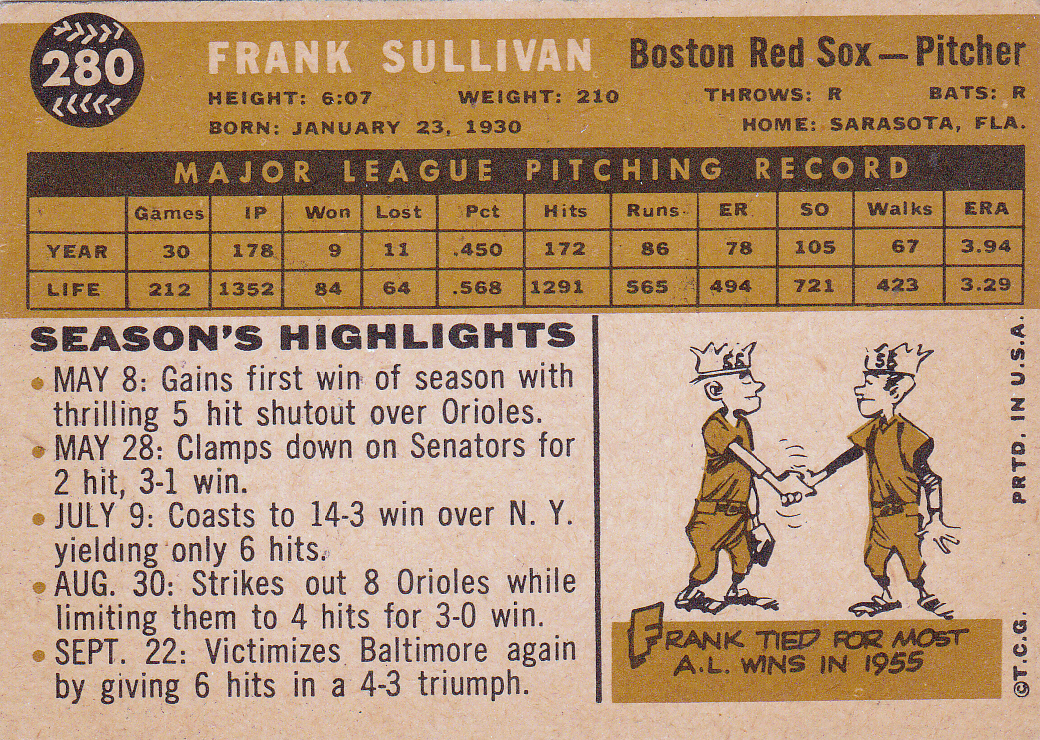
#280 Frank Sullivan


Frank Sullivan  Boston Red Sox

Career: Hollywood native Frank Sullivan had a nice run with the Red Sox in the mid-50s. He won 83 games over six seasons from 1954 through '59 for some less-than-impressive Boston clubs. He was twice and All Star and had a 3.24 ERA in that stretch. He tied Whitey Ford and Bob Lemon for the AL lead with 18 wins in 1955. he was the AL's WHIP leader in 1957 (although nobody then had thought of tabulating that stat).

Sullivan had debuted in Boston in 1953 by pitching rather unimpressively in 14 games. That shot had come after a long minor league stretch and a couple of years in the service during the Korean War. But in '55, as noted above, Sullivan came into his own and had a great run in Fenway. He remained with Boston through 1960 and then wrapped up his career with the Phils and Twins.

In 1960: This was Sullivan's last year for the Red Sox. His numbers dipped significantly from his days as the Sox' 'ace'. His ERA, which had never been above 4.00, ballooned to 5.10 and he lost sixteen against six wins.

Off The Charts: Sullivan's BR Bullpen page tells us..."Frank was the losing pitcher in the 1955 All-Star Game when he gave up Stan Musial's 12th-inning home run. Overall, he pitched creditably after entering in the 8th inning with the score tied, 5-5, and holding the National League scoreless for three plus innings. At the time, the only player in the majors taller than Sullivan was 6' 8" Gene Conley, the game's winning pitcher. Strange but true, after the 1960 season Sullivan was traded to the Philadelphia Phillies for Conley."

Sullivan was the model for one of the players in Norman Rockwell's painting entitled The Rookie. That's Sullivan wearing the #8 in the lockerroom.


Tuesday, October 27, 2020

#279 Chuck Tanner


Chuck Tanner  Cleveland Indians

Career: After signing with the Boston Braves in 1946 Chuck Tanner spent nearly a decade in their system before debuting in 1955 as a platoon outfielder and pinch-hitter. He went on to spend eight seasons (or parts thereof) with four clubs with more minor league duty sprinkled in.

Tanner hit .261 in nearly a thousand big-league at-bats with a touch of power. He wound up his playing days with a handful of games with the Angels in both 1961 and '62. He then entered the phase of his baseball career that he would become well known for, managing.

Tanner managed in the Angels system from 1963 through most of 1970. He was picked to pilot the White Sox for the final two weeks of the '70 season and went on to manage in the majors for 19 years, mostly for the Sox and Pirates. He led the 1979 Pirates to the World Series title over the Orioles. That was his only post-season managing experience. His career w/l as a skipper was 1352/1381.

Tanner later worked as a scout and in 'special assistant' and 'senior advisor' roles for the Brewers and Pirates until his passing in 2011 at the age of 82.

In 1960: Tanner spent most of 1960 with the Indians' Toronto AA club where he had a fine season. He spent almost two months in the midd of the year as the Indians primary pinch-hitter as he hit .280 in 30 appearances at the plate.

Off The Charts: Chuck's son, Bruce Tanner, pitched in ten games for his father's old club, the White Sox.

The Card: That's a pic taken in Seals stadium in San Francisco. I got the vibe from the color of the seats and what seemed to be hints of red among them which comes from the red railings surrounding the boxes. That much I've seen many times before. But the structure beyond the batting cage and the outfield wall puzzled me so I poked around and found plenty of photos that show exactly those elements at Seals. Easily seen in this picture.

And this one.


Sunday, October 25, 2020

#278 Stan Williams


Stan Williams  Los Angeles Dodgers

Career: Stan Williams, a Denver native, signed with the Brooklyn Dodgers in 1954 and worked his way up through their system over the next three seasons. In '58, with the club now on the West Coast, Williams had a fast start at the AAA level and was called to Los Angeles early in the summer. He made 21 starts and went 9-7 and he carved out a place for himself among the Dodgers' top shelf staff.
 
Williams, who at 6'3" 225 lbs was an imposing figure on the mound, won 43 games between 1959 and 1961 for the Dodgers. He averaged 163 strikeouts over that span.

In 1959 Williams lost his regular rotation spot in the second half of the season but got a huge win with three hit-less innings to wrap up the second playoff game over the Braves. He was traded to the Yankees for Moose Skowron in November of 1962 and was in the Bronx for two seasons, one as a starter and the next primarily out of the bullpen.
 
Williams moved on the the Indians, Twins, Red Sox and Cardinals before hanging up his glove and turning to coaching in the early 70s.
 
Williams served as a pitching coach for 14 MLB seasons, with the Red Sox, Yankees, Seattle Mariners, Chicago White Sox and Cincinnati Reds. He was also an advance scout for the Tampa Bay Devil Rays and Washington Nationals.

In 1960: Williams went 14-10 and made the NL All-Star squad. He was credited with a Hold in the second ASG of that year with two scoreless innings.

Off The Charts: Williams pitched very well in all of his postseason appearances. With the '59 Dodgers (World Series), the '63 Yankees (World Series, and the '69 Twins (ALCS) he totaled 11 innings over four games, allowed only three hits, no runs, and fanned eight. You can probably add the '59 playoff game since it was essentially a post-season game.

The Card: The yellow/blue/white combo and the Memorial Coliseum backdrop make for an attractive card.

Friday, October 23, 2020

#277 Harry Bright


Harry Bright  Chicago Cubs
 
Career: Harry Bright made his pro debut in 1946 with the Twin Falls (Idaho) Cowboys of the Class C Pioneer League, where he'd been assigned after signing with the Yanks as a 16-year-old. He got his final pro at-bat in 1971 as a player/manager in the Athletics chain. That's a span of 25 years. In between he played for five big league clubs and managed many minor league teams. He stayed in minor league dugouts as late as 1985 in the Expos chain. He'd also done work as a scout and instructor.
 
As a player, Bright did almost everything but pitch. He had his best (and busiest) season in 1962 with the Senators when he held down the regular first base post and hit .274 in over 400 at-bats. That year he even appeared as a catcher in three games. Over eight seasons he hit .255 and got to play in the '63 Series for the Yankees.
 
In 1960: Bright is shown with the Cubs, and he did play for them*, but not in 1960. He was 'returned' to the Pirates on the eve of the season after having been drafted away from them the previous winter. Bright had a big minor league season for Salt lake City in the PCL (27/97/.313/.370) and made a handful of pinch-hitting appearances that September after being called up to Pittsburgh. He was not on the Pirates roster to the 1960 Series.

*=Bright got back to Chicago in 1965 and played in 27 games for the Cubbies. It would be his last big-league year.
 
Off The Charts: Entertaining story from his SABR bio...
[...]Harry Bright played in nearly 2,000 games. None of his exploits on the playing field, not even all of his 1,966 major and minor league hits, earned Harry Bright as much notoriety as one time at bat in the 1963 World Series.

It was the opening game of the fall classic between the New York Yankees and the Los Angeles Dodgers. Behind the pitching of Sandy Koufax, the Dodgers had take a 3-2 lead into the ninth inning at Yankee Stadium. At the end of the eighth, a note on the scoreboard said that Koufax had tied the record for the most strikeouts in a World Series game. The first two outs in the ninth were routine putouts. With only one more chance for Koufax to break the record, Bright strode to the plate to pinch-hit for pitcher Steve Hamilton. He ran the count to 2 balls and 2 strikes before swinging and missing. Koufax had his record 15th strikeout, the crowd erupted, the Dodgers won the game, and Harry Bright became a footnote in the record books. “It’s a hell of a thing,” Bright said. “I wait 17 years to get into a World Series. Then when I finally get up there, and 69,000 people are yelling—yelling for me to strike out.”

 
The Card: Bright poses in Wrigley Field in his Pirates vest jersey with the batting cage behind him. That's fine but what I like about the card is the cartoon that shows him in his 'off season' job as a surveyor.
 

Wednesday, October 21, 2020

#276 Ken McBride


Ken McBride  Chicago White Sox

Career: McBride signed with the Red Sox when he came out of Cleveland's West High School in 1954. He immediately impressed with an 18 win season in Class D ball. He then spent another four years in their system with decent numbers but was dealt to the White Sox in 1959 and made his major league debut that August. He pitched well in that game and the few others he got into for the eventual AL champs but wasn't part of their post-season roster. 

Side note here: Baseball Reference lists his minor league time in '59 (19 starts in 26 games) as being with the White Sox' club at Indianapolis but he was sold to Chicago on August 1 of that year so I'm at a loss as to whats really up here. Maybe he pitched for the White Sox' organization while under contract to Boston. These little things bug me. 

Anyway, Chicago let McBride go to the Angels in the expansion draft and he hit his stride on the West Coast. He became the Halos' ace and won 36 games in his first three seasons there beginning in 1961. He even earned the start for the AL in the '63 All-Star Game. 

McBride hurt his arm in his second start in 1964 (he insisted on remaining in the game after a long rain delay) and was never again an effective pitcher. He was up and down between the Angels and the minors for two years and then retired.

In 1960: McBride pitched for San Diego in the PCL and had nice numbers. That earned him another late season call and he appeared in five games for Chicago that September. He was 0-1 while pitching 4 2/3 innings.

Off The Charts: From SABR...

McBride tried to stay in baseball. He managed in the minors for a year, and in the 1970s worked as a minor-league instructor and coach for the Milwaukee Brewers. In 1974 and 1975, he was the team’s major-league pitching coach. However, McBride said, “There wasn’t any money in baseball at the time unless you were a player.” After the 1975 season, at the age of 40, he moved back to Cleveland to raise his family. He became the co-owner and CEO of a construction company. As of 2008, he was still married to his high-school sweetheart, had two grown children and two grandchildren, and was still going to work every day at age 73. He remained a big fan of baseball and his hometown Indians, and watched their games every chance he got.

The Card: Old Comiskey Park makes an appearance. That red spot on the yellow background of the action shot doesn't seem to be on every copy of this card, only mine. But I swear that it's part of the card, not a stray ink mark.

Check that, I found another one that was on eBay. Maybe I've got a rarity!! Maybe I'm rich!!


Nah.

Monday, October 19, 2020

#274 Tom Acker


Tom Acker  Kansas City Athletics

Career: Acker is another pitcher who took a long road to the bigs. He first signed with the Giants in 1948, spent two years in the employ of Uncle Sam, was dealt to the Reds and debuted with them in 1956.

Over four full seasons he went 19-13 with a 4.13 ERA, mostly as a reliever. He had some spot starts most seasons with the Reds. As the card notes he had his best season in 1957 when he won 10 games.

In 1960: Acker had been dealt to the Athletics the previous winter but be was done with the majors. He ended up pitching in a few games for the Yankees' AAA club in Richmond. He was hit hard by the look of his numbers and was out of baseball soon after.

Off The Charts: Not much info on Ackers. I did discover that his nickname was 'Shoulders'. That's more than I found when I was researching him for his 1959 card.

The Card: Whatever that blue blob is that snuck onto Acker's left shoulder is seen on every copy. Some sort of printing flaw.